
We create digital solutions that work for businesses
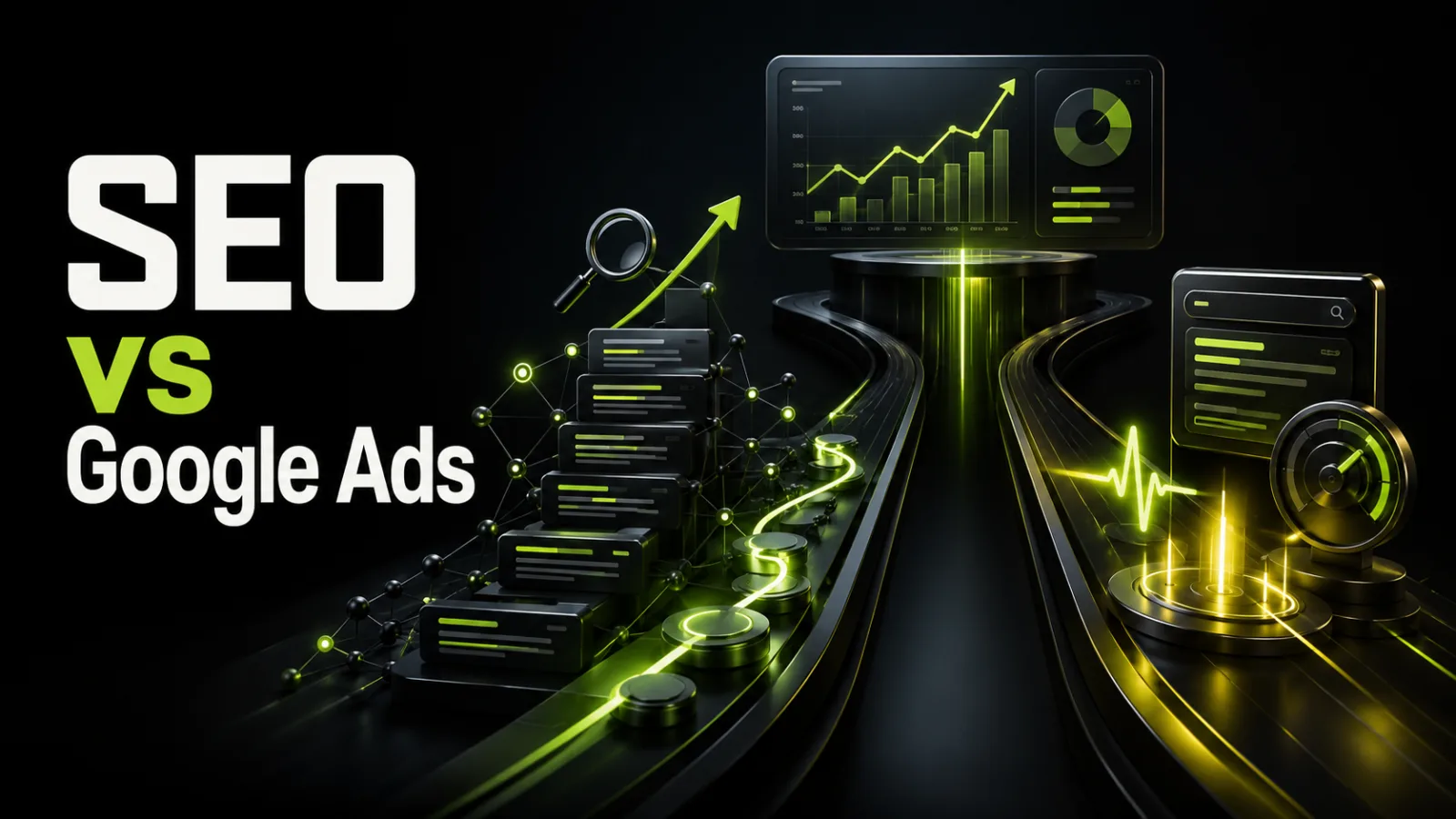
“Which works better, SEO or Google Ads?” is the wrong starting point. Both appear in search, but they solve different problems. Ads can quickly place an offer in front of people who are already searching. SEO helps a website build systematic visibility across a wider set of organic queries.
The decision depends on urgency, website readiness, budget, margins, competition and planning horizon—not on a universal winner.
Choose Google Ads to test demand quickly, launch a new offer, collect search-query data or support a seasonal campaign.
Choose SEO when demand is stable, the business can invest in structure and content, and reducing dependency on paid clicks matters.
Use both when the company needs leads now and wants to develop a long-term organic channel.
Google explicitly separates PPC and SEO. Paying for Google Ads does not improve organic rankings; each channel creates visibility through a different system.
SEO is ongoing work on technical accessibility, website architecture, content, search intent, internal links, reputation and user experience. Google describes it as helping search engines understand content and helping people find a site and decide whether to visit.
Typical SEO work includes:
resolving crawling and indexing issues;
keyword research and page architecture;
optimizing titles, headings and content;
creating service, category, location and informational pages;
improving speed and mobile usability;
internal linking and authority development;
analyzing Search Console and conversions;
updating pages as demand and competition change.
SEO is not free. There is no direct payment to Google for an organic click, but strategy, development, content, design, analytics and expertise require resources.
Google Ads lets advertisers display paid listings in Search and other Google surfaces. Search campaigns can control queries, geography, schedule, landing pages, budget and goals.
Every eligible impression enters an auction. Google determines whether the ad appears and its position. The highest bid alone does not automatically win; Ad Rank, quality and other signals matter.
The full cost may include ad spend, campaign management, landing-page work, conversion tracking, creative production and technical integrations. When a campaign stops, paid exposure normally stops as well. The data can still improve future pages and offers.
| Criterion | SEO | Google Ads |
| Placement | Organic results | Clearly labeled paid placements |
| Speed | Builds gradually | Can start after setup and approval |
| Direct click fee | None | Payment follows the campaign model |
| Main investment | Technical work, content, authority | Media budget, management, pages, analytics |
| Query control | Indirect through relevance and structure | Greater control over keywords and targeting |
| Forecasting | Limited at the beginning | Improves after conversion data accumulates |
| Duration | Visibility may continue after activity slows | Exposure depends on an active campaign and budget |
| Best role | Long-term demand coverage | Fast demand capture and testing |
Google Ads can produce traffic quickly, but fast impressions do not guarantee profitability. Early data often reveals irrelevant queries, weak landing pages and the difference between a form submission and a sale. Campaigns should optimize toward meaningful conversions.
SEO timing depends on the domain, competition, indexing, scope and publication speed. Google notes that some changes may be reflected in hours while others can take weeks or months. A guaranteed ranking by a fixed date is therefore not a credible promise.
The answer changes with the time horizon. Ads are easier to calculate in the short term because spend, clicks and conversions are visible. SEO often requires upfront technical and content investment before substantial traffic appears.
Over time, strong organic pages can generate visits without a fee for every click. They still require maintenance and improvement. Compare the full funnel rather than monthly invoices:
channel cost → qualified leads → sales → gross profit
For SEO, include all work when calculating organic cost per lead. For Ads, add management, pages, analytics and sales follow-up to media spend.
Prioritize SEO when demand is stable, the site has a long future, many services or categories need coverage, paid clicks are expensive, customers research before buying and the team can maintain useful pages.
SEO is especially valuable for B2B, healthcare, legal services, education, construction, ecommerce catalogues and businesses with many detailed queries.
Prioritize Ads when leads are needed quickly, a new offer requires validation, demand is seasonal, one service or category is the focus, organic visibility is still weak and conversion tracking is ready.
Advertising cannot fix weak demand, an uncompetitive offer or poor lead handling. It simply delivers people to the current proposition faster.
Ads can produce early traffic while search engines discover and evaluate new pages. SEO simultaneously builds the structure for future organic demand.
Paid-search data reveals real query wording and conversion potential. A high-click keyword should not automatically become an SEO priority; verify sales and intent first.
Ads can support profitable terms while organic pages are still developing. When rankings improve, reallocate budget based on total sales rather than turning campaigns off automatically.
Prepare SEO pages before the season and use Ads to increase visibility during the demand peak.
Paid traffic can reveal weak headlines, proof, offers and forms faster. Improvements often benefit paid traffic, organic visitors and sales teams at the same time.
| Situation | Priority | Reason |
| New site with no visibility | Ads + SEO | Immediate data and a long-term foundation |
| Urgent local service | Ads + local SEO | Capture current demand and improve map visibility |
| B2B with a long sales cycle | SEO + selective Ads | Content builds trust; Ads supports high-value queries |
| Large ecommerce catalogue | SEO + Shopping/Ads | Organic category growth and controlled product promotion |
| Seasonal offer | Ads, SEO prepared early | Speed during the peak and a reusable organic asset |
| New service with uncertain demand | Small Ads test | Validate wording and conversion before scaling |
| Very limited budget | One focused priority | Spreading spend prevents either channel from learning |
There is no universal percentage.
Fast-start model: more budget goes to Ads, while a smaller part funds technical SEO and initial pages.
Balanced model: both channels run together; Ads supports current sales and SEO expands non-brand reach.
Organic-priority model: most investment goes to architecture, content and technical improvements; Ads remains for seasonal, branded, new or highly profitable areas.
Review the split after collecting data about lead quality, sales, margins and organic growth.
For Ads, monitor spend, search terms, conversions, qualified leads, sales, revenue, ROAS and lost impression share. For SEO, monitor indexing, non-brand impressions and clicks, visibility, organic leads, sales, cost per organic lead and pages that consistently deliver value.
Use one business funnel:
channel → landing page → key action → qualified lead → sale → gross profit
Analytics alone cannot confirm lead quality. Connect source data to CRM and completed sales, including offline deals where relevant.
treating SEO as free traffic;
launching Ads without meaningful conversion measurement;
sending paid traffic to a weak generic page;
expecting instant SEO growth;
pausing Ads immediately after organic visibility improves;
assuming ad spend affects organic ranking;
comparing clicks rather than gross profit;
changing multiple campaign and website variables at once.
Define whether the priority is immediate sales, demand validation, organic growth or reduced paid dependency.
Confirm that relevant search demand exists.
Calculate average order value, gross margin, sales conversion and allowable CAC.
Audit website structure, content, speed and conversion readiness.
Track forms, calls, purchases, lead source, lead quality and offline sales.
Choose Ads, SEO or a parallel launch.
Set business metrics rather than traffic-only targets.
Run a controlled test without changing everything at once.
Reallocate budget toward repeatable profit.
Google Ads is stronger for fast launches, testing and controlled paid demand. SEO is stronger for building durable organic visibility and expanding an owned digital asset.
Most businesses should assign each channel a role instead of choosing one forever. Ads provides immediate data and leads, SEO gradually captures more relevant searches, and shared analytics reveals actual profitability.
BB STUDIO can audit the website, create its SEO architecture and landing pages, and configure measurement so budget decisions are based on sales rather than assumptions.
No. Buying ads does not raise a website’s organic position. SEO and Ads can use the same queries and pages, but their placement systems are separate.
With existing demand, a suitable page and correct setup, Google Ads normally generates traffic faster. SEO needs time for technical work, content, crawling, indexing and evaluation.
Sometimes spend can be reduced, but test the effect first. Ads may remain profitable for seasonal, branded, new and high-converting searches.
Build the SEO foundation and run a focused Ads test if leads are required. This creates early data without postponing organic development.
Pass lead-source data into CRM and compare full costs, qualified leads, sales and gross profit. Clicks and raw form submissions are insufficient.
 For business
 SEO
SEO
 Web development
 Web development
 Let’s create something amazing together
 Leave your number — we will call you back within 15 minutes during working hours.
We will call you back shortly.

