
We create digital solutions that work for businesses
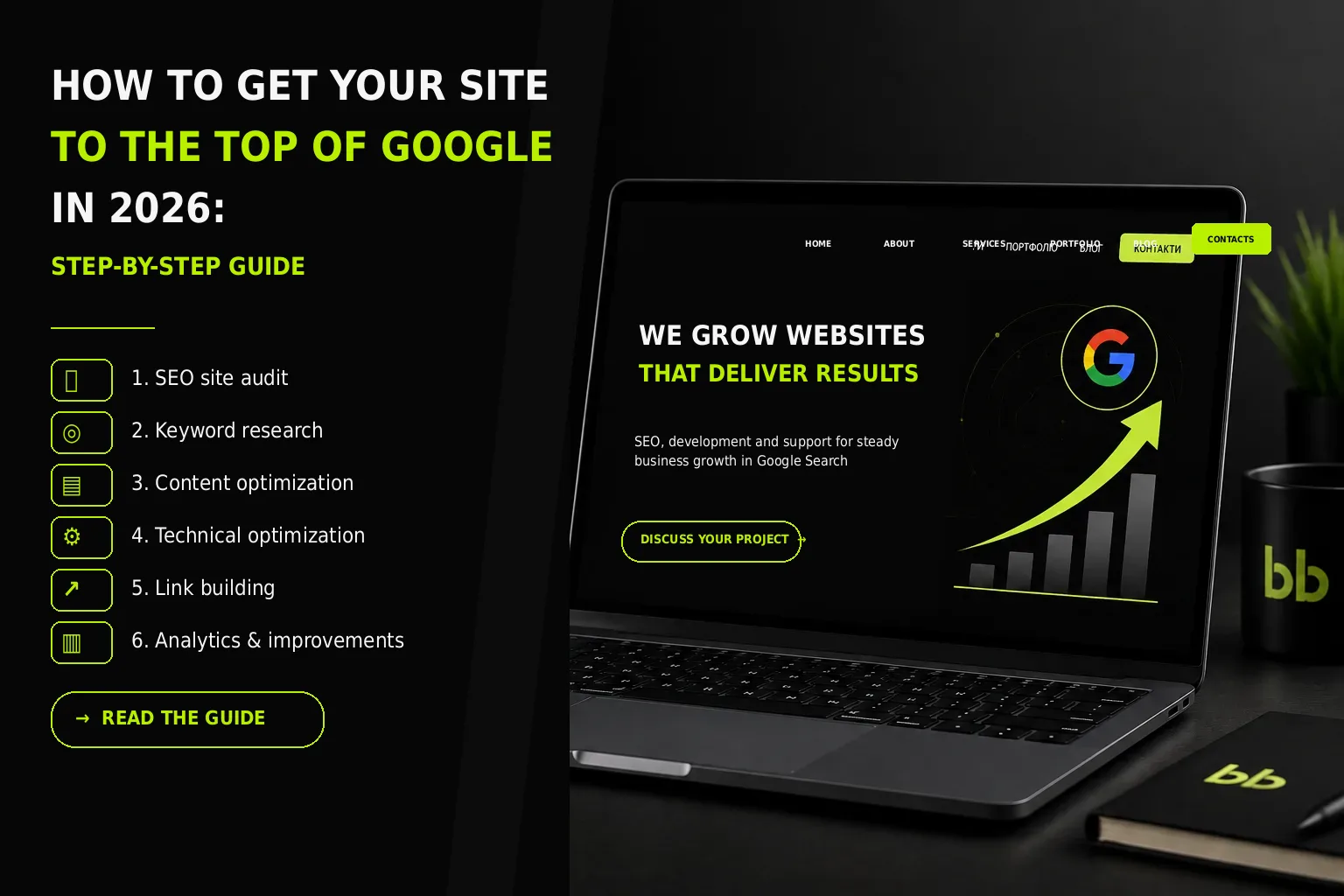
“Get my site to the top of Google” is the most common request business owners bring us. But very different tasks hide behind that sentence: one company needs leads from two or three commercial queries, another wants blog traffic, a third simply wants to be found by its own name. The path is different in each case.
This is a step-by-step guide with no magic and no “secret methods”. It is the sequence we follow ourselves when we take a client’s site from zero: from checking indexing to links and local results. At the end there is a checklist you can work through on your own.
It used to be simple: ten blue links, and the job was to reach the first three. A results page looks different now. Ads sit above the organic listings, a map pack with local businesses sits below them, then come “People also ask”, videos, images and an AI summary. Organic result number one physically lands in the middle of the screen.
The practical conclusion: “be first” is the wrong goal. The right goal is to own the part of the results page that brings customers for a specific query. For “web design agency Kyiv” that means organic plus Google Maps cards. For “how much does a landing page cost” it means a detailed answer and a place in the questions block. For a brand query it means your own pages, not somebody else’s.
Most disappointment comes from unrealistic expectations. These are the benchmarks we give clients during the first call:
| Situation | First results | Stable positions |
| New domain, from scratch | 3–6 months | 8–12 months |
| Older site with history | 1–3 months | 4–8 months |
| Low-competition queries | 1–2 months | 3–5 months |
| High-volume commercial terms | 6–12 months | a year and up |
Google does not trust a new domain straight away, and that is sensible caution rather than punishment. A site can be technically flawless, with excellent content, and still sit on page three for the first few months. That is a normal stage, not a sign that something went wrong.
Why so long? Google has to be sure the site will not disappear in a month, that other resources link to it, and that people who land on it find what they were looking for. Collecting that evidence takes months of observation. So the worst strategy is to build a site, wait six weeks, decide SEO does not work and abandon it. That is exactly the point where most people give up.
The second reason for the delay is competitors. If the niche already has five-year-old sites with hundreds of links, you cannot pass them in a quarter. That is no reason to skip the work: enter through less competitive queries, build traffic there and move up gradually.
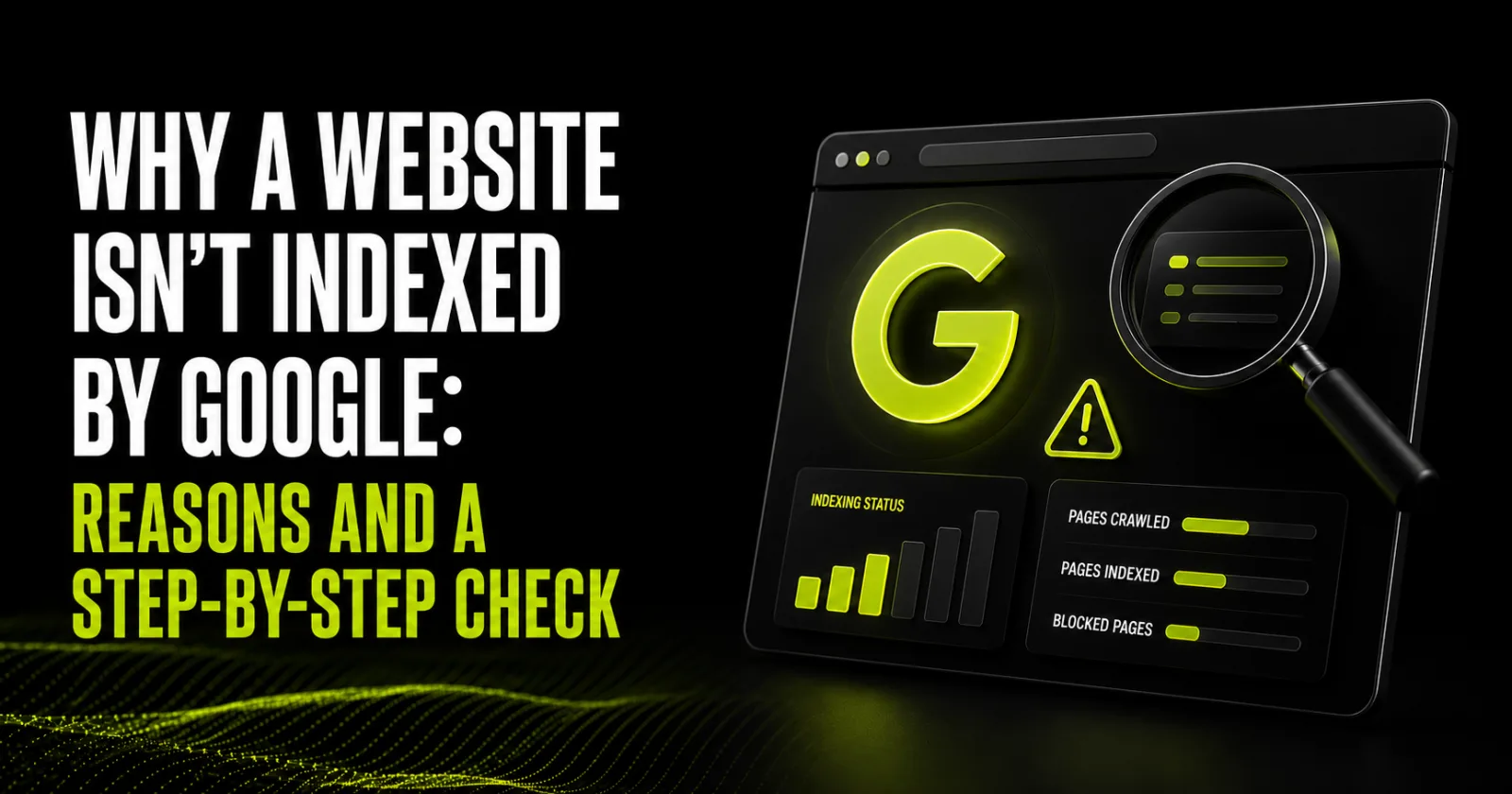
Before talking about positions, check the basics: can Google see you? Search for site:yoursite.com and you will get an approximate count of indexed pages. If there are no results, or far fewer than the pages you actually have, there is no point going further.
Next comes Google Search Console. It is free and non-negotiable: without it you are working blind. The “Page indexing” report shows which URLs are in the index, which are not, and why.
The most common reasons pages are missing from search:
Disallow: / in robots.txt — the classic after moving from a staging domain. The costliest mistake in SEO: traffic disappears within weeks.Check your sitemap separately: sitemap.xml belongs in the site root, should contain only canonical URLs, and must be submitted in Search Console. Paginated pages, utility sections and noindex URLs do not belong there.
A beginner’s mistake is inventing queries from imagination. The way a business phrases things and the way a customer phrases them almost never match: you say “web resource development”, people search “build a website price”.
Where to find real queries:
Then split what you collected by intent. This matters more than search volume:
| Query type | Example | Page it needs |
| Commercial | order a landing page | service page with price and form |
| Informational | how to choose hosting | blog article |
| Navigational | brand name reviews | reviews page |
| Local | web studio Kyiv | geo page plus Google Business |
The most frequent mistake is trying to rank the homepage for a commercial query that deserves its own service page.
One more thing worth understanding early: do not chase the highest-volume terms. Thousands of people search “website development” every month, but agencies with budgets and years of history already sit there. “Turnkey website for a dental clinic” is searched far less often — yet competition is lower, the intent is clearer, and the person typing it is much closer to ordering.
These refined queries are called the long tail. Individually each brings little traffic, but together they usually generate more leads than a handful of head terms. And crucially, you can realistically reach them in months rather than years.
The rule is simple: one group of queries, one page. If you want to rank for “e-commerce development”, a dedicated page about exactly that must exist — not a paragraph on your Services page.
The reverse mistake is just as common: several near-identical pages for similar queries. They then compete with each other and Google cannot tell which to show. This is called cannibalisation. “Website development” and “website creation” express one intent, and one page should serve it.
The symptom: in Search Console, different URLs of yours take turns appearing for one query and none holds a position. The cure is to merge them into a single strong page and 301-redirect the rest.
This can be done in one evening, costs nothing, and the effect is visible. Internal links do two jobs: they show Google which pages matter most, and they pass authority to them.
The rules we apply:
Checking is easy: open any service page and count how many internal links point to it. If there are none besides the menu, you have found the reason it is not growing.
Google does not judge length; it judges how completely a page answers the query. But there is an empirical observation: in competitive topics, pages of 400–500 words almost never appear at the top. Not because length is magic, but because a complex question cannot be answered briefly.
What makes a page strong:
Trust deserves its own paragraph. Google evaluates pages through E-E-A-T: experience, expertise, authoritativeness, trustworthiness. For a service business this means very down-to-earth things: real case studies linking to live sites, names and photos of your team, company registration details, a contact page with an address and phone number, reviews with names. An anonymous site with nothing to prove real people stand behind it competes poorly in commercial topics.
This matters most where the decision is expensive. If someone is choosing a contractor for a project worth thousands, they check who they are paying. An “About us” page with three paragraphs of generic wording does not help; a case study with “launched in 18 days, enquiries up 40%” does.
A word on metadata. The title tag is the strongest text signal: keep it under 60 characters and put the main query near the beginning. The description does not affect ranking directly, but it decides whether people click your result. There should be exactly one H1 per page.
Speed is not the main ranking factor, but it shapes behaviour: if a page loads slowly, people return to the results, and that is noticeable.
The minimum that delivers the most:
loading="lazy" and explicit width and height;defer or async rather than blocking ones in <head>.And separately, the mobile version. Google evaluates your site by how it looks on a phone, so check everything there first, not on a wide monitor.
Schema.org markup does not lift positions directly, but it changes how your result looks — and that directly affects clicks. The same line with star ratings or an expandable list of questions clearly outperforms its neighbours.
What to mark up on a services site:
| Markup type | Where to use it | What it adds in results |
| Organization | homepage | company card, logo |
| BreadcrumbList | all inner pages | a path instead of a bare URL |
| FAQPage | pages with questions | expandable answers |
| Article | blog posts | date, author, image |
| AggregateRating | reviews page | star rating |
You can validate markup free of charge in Google’s Rich Results Test. One rule matters: only mark up what genuinely exists on the page. Star ratings without real reviews are a violation, and the penalty removes rich results for the whole site.
This is the usual bottleneck. We regularly see the same picture: the site is technically flawless, the content is good, everything is indexed — and nothing grows. The reason is singular: nobody links to the site, so Google has no grounds to consider it authoritative.
What works and carries no risk:
What to avoid: buying links in bulk from marketplaces, placing them en masse in other sites’ footers, or industrial-scale “you link to me, I link to you” swaps. That is the fast route to a penalty, and recovering takes longer than growing honestly.
If you serve a specific city, Google Maps cards often produce more enquiries than organic listings — and getting in is easier.
What needs doing:
That last point deserves emphasis. Twenty pages where only “Kyiv” changes to “Lviv” are what Google calls doorway pages. They do not rank, and they drag down the quality assessment of the whole site. Five real pages with local case studies, prices and market specifics beat twenty empty ones.
A generated answer assembled from several sources increasingly appears above the results. For a site owner this means two things, and both are worth planning for.
First: for simple informational queries, some people get their answer immediately and never visit a site. Traffic to “what is X” style articles is gradually shrinking, and nothing can be done about that.
Second, and more important: becoming one of the cited sources is entirely achievable, and it puts your brand above the whole organic listing. What helps:
The strategic conclusion: shift emphasis away from purely informational topics towards commercial and local queries, where the person has to visit your site to make an enquiry anyway. “How to choose a contractor” keeps its value; “what is a landing page” delivers less every month.
Positions are a misleading metric: they differ by person and by city. Watch this sequence of signals instead, in this order:
Impressions without clicks are not a failure. They mean you are already in the results, just deep. Those queries are the cheapest reserve you have: strengthening a page you already appear for is far easier than entering a new topic from zero.
An honest split of effort. Part of the work an owner can do personally and at no cost — and that part often produces the biggest initial jump.
| Task | On your own | Needs a specialist |
| Connect Search Console | yes | — |
| Fill in Google Business, gather reviews | yes | — |
| Write copy about your services | yes, you know the business best | editing |
| Fix robots.txt, canonicals, redirects | risky | yes |
| Speed and Core Web Vitals | no | yes |
| Structure built around semantics | partly | yes |
A sensible plan for a small business: cover the basics yourself within a week, then hand the technical work and structure to a specialist as a one-off project. A monthly retainer makes sense once you are in a competitive niche and publishing regularly.
A sudden fall is alarming, but there is almost always an explanation. Check in order, from the simplest:
Disallow. Someone pushed a staging configuration to production.What you should not do is panic-rewrite the entire site. Find the cause in Search Console first: it shows both the date of the drop and exactly which pages and queries lost ground.
site:yoursite.com and add the site to Google Search Console.Disallow: /.sitemap.xml in Search Console.It is not a fast route, but it works and creates no risk. If you need help with the technical side or the structure, get in touch — we will look at your site and tell you exactly what is holding growth back.
 Google Ads
 SEO
SEO
 Analytics and Conversion
 Analytics and Conversion
 Let’s create something amazing together
