
We create digital solutions that work for businesses
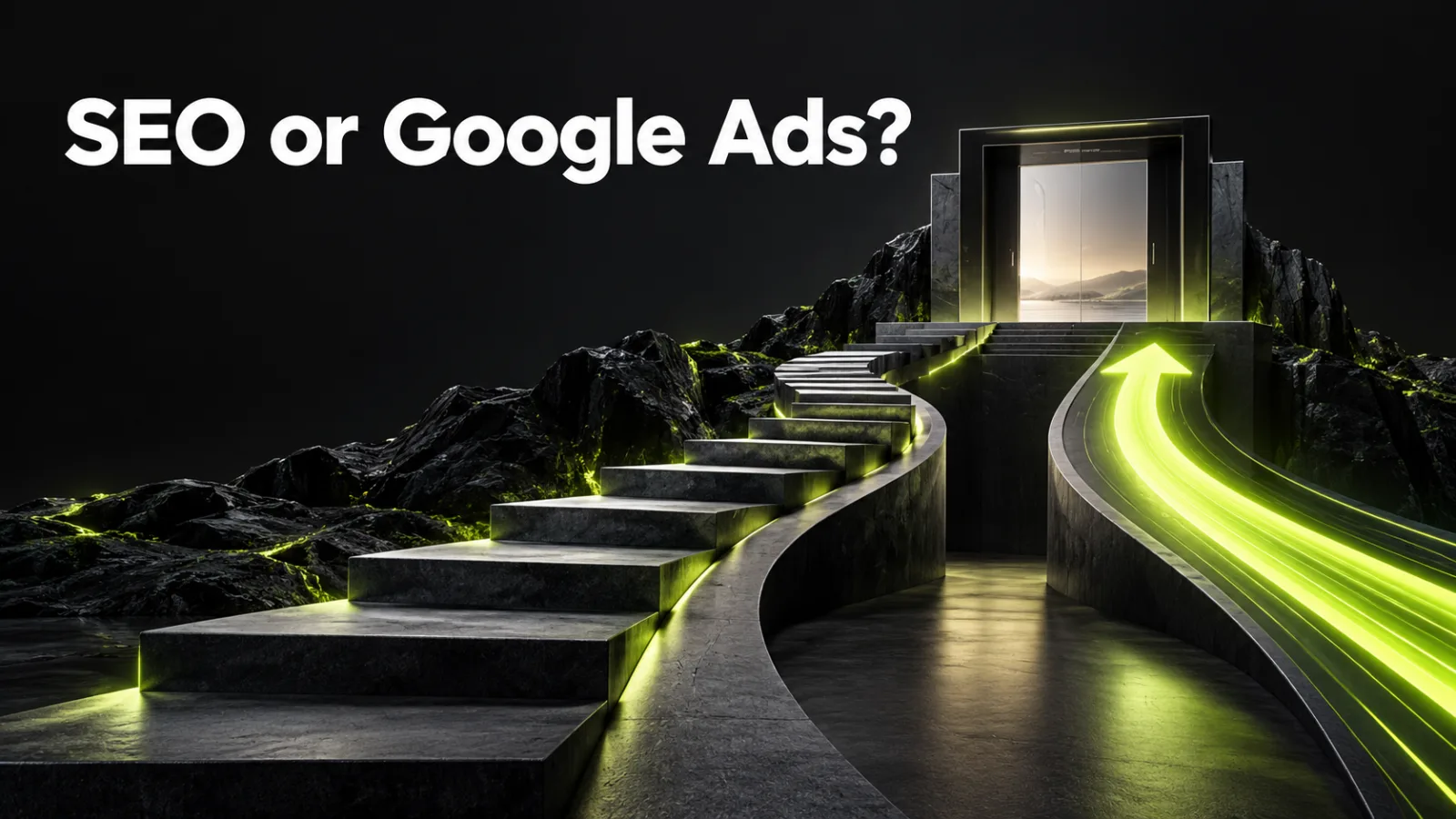
When a business needs customers from Google, the choice often comes down to SEO or Google Ads. Advertising can bring visitors sooner, while search optimisation develops organic visibility. Neither traffic volume nor launch speed tells you which channel will be profitable for your business.
This guide compares the two from an owner's perspective: resources, timing, acquisition costs and the situations in which each option makes sense. Google Ads here mainly means Search campaigns. Shopping, video, Display and Performance Max require additional planning and should not be treated as identical products.
Consider Google Ads first when you need to test existing demand, promote a specific service or support a seasonal offer. Consider SEO when you want to develop a lasting search presence and can commit resources over time. Using both can make sense when your budget and team can support meaningful work on each channel.
Before choosing, answer three questions: do people search for your offer, can the landing page persuade them, and how much can you spend to acquire a customer? A broken form or unanswered enquiries will undermine either channel.
SEO involves your website's structure, technical condition and content. It helps search engines understand pages and helps people find a relevant answer or offer. There is no Google charge for an organic click, but research, content, development and maintenance still require resources.
Effective website SEO services start with business priorities. A retailer needs useful category pages with available products; a service company needs clear pages for its main services. Publishing more articles without connecting them to a commercial offer is not a complete strategy.
Search advertising lets businesses compete to show ads to people searching for related products and services. You manage campaigns, budgets, locations and other settings. A bid alone does not guarantee the highest position: Google also considers quality and search context [3].
Google Ads setup and management should include landing-page checks and reliable enquiry tracking, as well as relevant targeting and ads. A stream of unsuitable calls can look busy while contributing little to actual sales.
| Criterion | SEO | Google Search ads |
|---|---|---|
| Starting traffic | Depends on the website, demand and competition | Possible once preparation, review and serving requirements are met |
| Main costs | Specialist work, content, development and maintenance | Media spend, management and landing-page work |
| Control | Through pages, content and website quality | Through campaign settings within platform capabilities |
| Pausing investment | Some visibility may remain, without a guarantee | Paused campaigns stop generating new ad impressions |
| Seasonal offers | Require advance preparation | Offers and budgets can be adjusted promptly |
| Scaling | By improving coverage and useful pages | Limited by demand, auctions and acceptable acquisition costs |
| Business evaluation | Qualified enquiries, sales and costs over time | Qualified enquiries, sales and fully loaded acquisition costs |
Google Ads usually allows you to start testing a commercial offer sooner. However, launching a campaign is only the beginning. An impression must become a visit, an enquiry, a qualified opportunity and eventually a sale. A complex B2B contract may take much longer to close than an urgent household service.
SEO has no universal deadline either. Google's guidance explains that search changes may take anything from hours to months to appear [1]. A promise of first-place rankings within 30 days, made without examining the website and competition, is not a reliable planning assumption.
Set separate milestones for completed work, relevant visibility, qualified leads and closed sales. Our guide on getting a website to the top of Google covers the organic development process. The purpose of this comparison is to decide where investment should go first.
The claim that SEO is free while advertising costs money leaves out most of the work. Organic visibility requires investment even when Google does not charge for the visit. Equally, paying the advertising platform is only one part of a paid-search budget.
For SEO, include specialists, content, development and necessary tools. See our breakdown of website SEO costs for the components. For advertising, separate media spend from setup, management and landing-page improvements; our guide to Google Ads budgets explains that distinction.
The following figures are educational assumptions, not BB STUDIO prices, market averages or forecasts. Suppose a business spends UAH 30,000 on one channel during a reporting period, including all work allocated to it. It receives 1,000 visits, 40 enquiries and 10 new customers.
If each order contributes UAH 4,000 after variable costs, ten orders contribute UAH 40,000 before marketing and fixed overheads. Deducting UAH 30,000 of marketing leaves UAH 10,000 before fixed overheads. That remainder is not net profit.
Keep media metrics separate. For example, UAH 20,000 spent on 1,000 paid clicks produces an average CPC of UAH 20 [4]. Dividing only that media spend by customers understates the full acquisition cost when management and development are additional expenses.
For SEO, examine cumulative costs and results over an agreed period, rather than relying on a single month. Separate first purchases from repeat orders. Use consistent attribution rules and CRM records so that the same customer is not counted as a new acquisition by two channels.
Start by checking whether the website is ready to generate business. The offer must be clear, forms must work, mobile visitors must be able to use it, and pricing or quotation procedures must be understandable. A new domain can receive organic traffic, but a sales plan should not assume immediate search growth.
A practical approach is to prepare core service pages and measurement, test a narrow offer through advertising, and develop the organic structure progressively. This is not always appropriate: if people rarely search for a new product, search advertising may have little demand to capture. You may first need channels that introduce the product to its audience.
For cleaning, repairs, automotive services or consultations, examine searches for specific services in the relevant city. Ads can test enquiries in a selected area, while SEO develops service-page visibility. Assess the Google Business Profile and local results separately instead of combining every source under website organic traffic.
Compare channels by category, margin and stock availability. Neither SEO nor ads can make unavailable products or uncompetitive terms attractive. Search campaigns can test selected categories while organic work develops category and product pages. Shopping and Performance Max need their own feed, planning and evaluation.
For manufacturing, construction or complex integrations, the relevance of an enquiring company matters more than the number of forms submitted. One suitable contract can justify substantial marketing costs; many unsuitable leads may not. SEO can explain expertise through services and case studies, while ads test existing commercial demand. Evaluate outcomes over the real sales cycle.
Prepare organic pages ahead of the season. Tie advertising to actual capacity: available appointments, staff or stock. More traffic is not useful if the business cannot fulfil additional orders. During a short peak, the response speed of your team may be as important as the choice of channel.
Do not split a small budget equally simply to say that both channels are active. First ask whether you can fund a meaningful advertising test and still afford to fix the landing page. If not, narrow the service, geography or set of queries under investigation.
If the website already generates organic leads, improving existing pages may be more useful than starting a new channel. If you need bookings for a specific upcoming period, assess a focused ad test. These are scenarios to validate, not a universal recommendation to allocate 70% to one channel and 30% to another.
Write down the decision before work begins: the offer, customer type, test budget, review date and conditions for continuing. This prevents the plan from changing every time a competitor appears in the results.
A combined approach is useful when each channel has a clear role. Advertising can test a priority service while SEO develops useful pages and answers to customer questions. Paid lead quality can inform commercial content priorities, although an ad's conversion rate does not predict the same rate in organic search.
Spending on Google Ads does not improve organic rankings; Google explicitly separates the systems [2]. Similarly, reaching a strong organic position is not by itself a reason to switch off ads. Test the effect on total qualified enquiries, allowing for seasonality and brand demand. Analyse branded queries separately so that existing recognition does not hide weak acquisition of new audiences.
If traffic already exists but enquiries are scarce, investigate why website visitors do not become leads first. Use our Google Analytics 4 setup guide to establish measurement, then reconcile the reports with actual enquiries. An SEO audit can identify technical indexing barriers and page issues that deserve attention before expansion.
Days 1–14: identify the priority service, acceptable customer acquisition cost and data sources. Review demand, current visibility and website readiness. Agree on the definition of a qualified enquiry and the expenses included in evaluation.
Days 15–30: launch the selected work. Ads might test one focused offer; SEO might remove critical barriers and improve priority pages. Record the starting metrics and all meaningful changes.
Days 31–60: review traffic relevance, lead quality and sales handling. Address bottlenecks in sequence. Keep a hypothesis log instead of repeatedly changing settings without a clear reason.
Days 61–90: reconcile spend with customers, recognised revenue and contribution. Decide what to continue, what to change and whether a second channel is justified. For SEO or a long B2B sales cycle, 90 days may be an interim review rather than a payback deadline.
The decision depends on demand, website readiness, timing and order economics. Consider Google Ads for a faster test of existing search demand. Plan SEO for progressive growth in organic coverage. Where resources allow, coordinate both around shared business measures.
BB STUDIO can assess your website, priority services and promotion options. Discuss your project with BB STUDIO to receive a proposal with a defined scope and clear criteria for evaluating progress.
 SEO
 SEO
 SEO
 Hosting & tech
 Let’s create something amazing together

