We create digital solutions that work for businesses
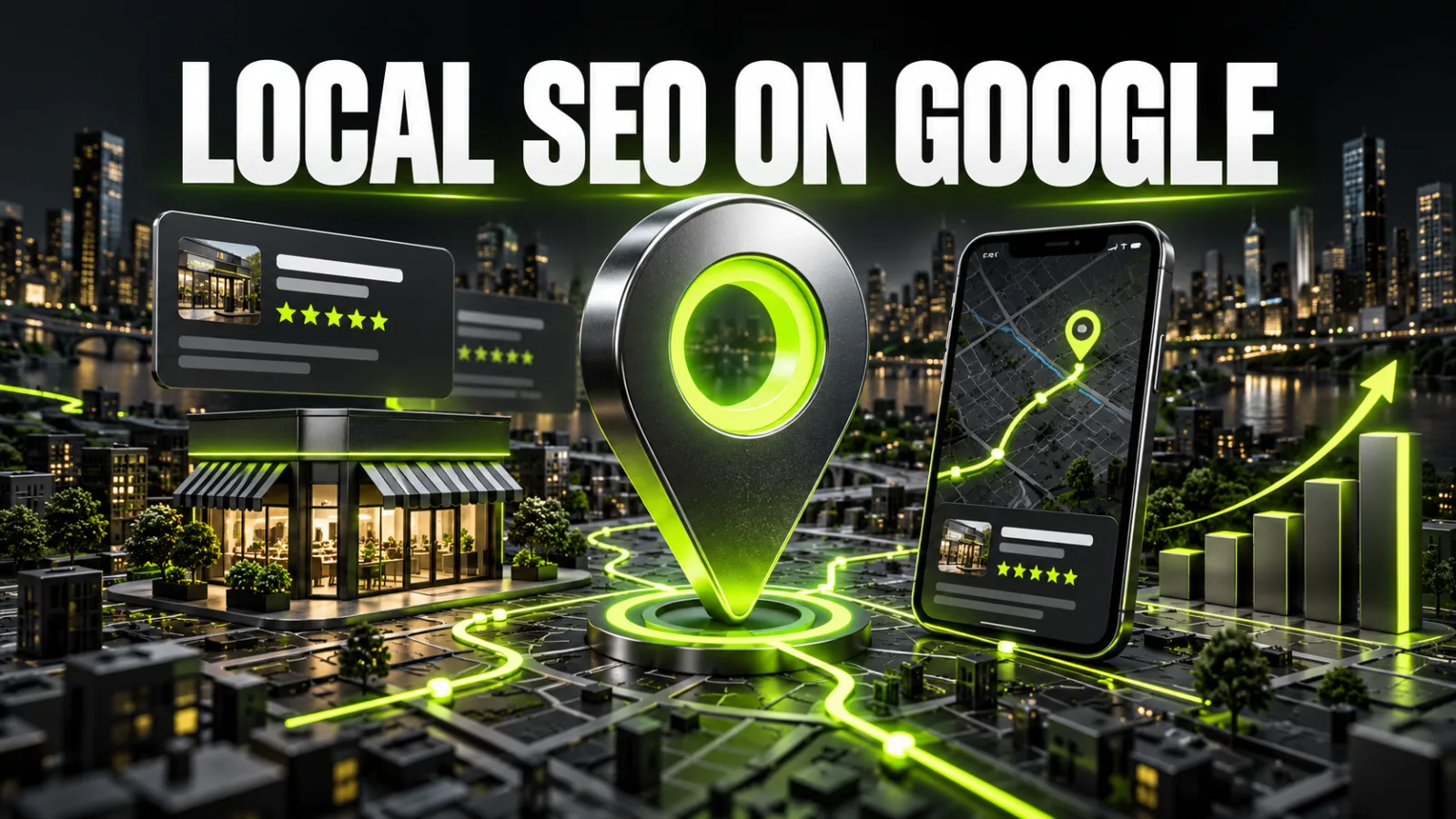
When someone searches for “dentist near me,” “laptop repair in Warsaw,” or “coffee shop nearby,” Google attempts to show businesses that are both relevant and practically accessible. Search results may include a map, several Business Profiles, organic pages, directories, and paid placements.
Local SEO helps a company become visible in these situations. It is relevant to clinics, salons, restaurants, shops, service centers, law firms, contractors, and other organizations that serve a defined location or travel to customers.
No single setting creates the result. The Business Profile, website, categories, service pages, location details, reviews, local mentions, and analytics need to support the same real-world business. This guide provides a practical process without spam or risky shortcuts.
Local SEO is the optimization of a company’s digital presence for searches with geographic intent. The location may be written in the query or inferred from the user’s approximate position.
Local visibility spans several surfaces:
The Profile and website serve different roles. The Profile quickly explains who the company is, where it operates, when it is open, and how to call or get directions. The website explains services, prices, staff, proof, and conditions in depth. This is why systematic website SEO cannot be replaced by map optimization alone.
Google describes three primary groups of factors: relevance, distance, and prominence.
Relevance reflects how closely the Profile and website match the search. It is supported by the primary category, relevant secondary categories, services, descriptions, page content, and a clear business focus.
Distance reflects how far the business is from the location in the query or the user’s inferred location. Text optimization cannot override geography. A company should not create fake addresses or virtual offices merely to target neighboring cities.
Prominence describes how well known the business is offline and online. Signals can include mentions, links, organic visibility, reviews, ratings, and the completeness of information. There is no public score or guaranteed formula.
An important consequence is that an excellent Profile cannot guarantee the first position for every user. Results vary by search point, query, time, device, and competitive environment.
Business Profiles are intended for organizations that receive customers at a stated location or meet them in person within a service area. A purely online business without in-person contact is generally not eligible. Renting a virtual address does not make it a legitimate customer-facing location.
| Model | What to display | Example |
|---|---|---|
| Storefront | address, hours, directions | shop, clinic, restaurant |
| Service-area business | service area, with a private address hidden | cleaning, repair, installation |
| Hybrid | address and service area | workshop with a mobile team |
Review the current Google guidelines before creating the Profile. Incorrect names, ineligible addresses, and duplicate Profiles may lead to restrictions or suspension.
First check whether a Profile already exists. It may have been generated automatically or created by a former employee, vendor, or customer. Do not create a duplicate; request ownership or management access.
Complete verification using a method offered by Google. The business cannot always choose the method. The owner should control the primary account, while an agency or contractor receives a separate manager role.
The primary category should describe what the business is, not list everything it sells. A dental practice may use a dental-clinic category rather than a broad medical-center label. Secondary categories should represent genuine related activities.
Do not add distant categories just to gain impressions. They dilute the business focus and can create false expectations. Competitor research is useful, but each selected category must be supported by the website and real operations.
The Profile name should match the name used on signage, documents, and the website. Do not add cities, services, or keywords unless they are genuinely part of the business name.
Verify:
After a move, update the existing Profile rather than immediately creating another one. Complete any required re-verification and update the website at the same time.
A service-area business should hide a private or non-customer-facing address and specify the real operating area. Do not select an entire country when the team cannot serve it. A large service area does not make the Profile rank equally across every city.
Each priority city needs actual operational coverage, a relevant page, and evidence that the business works there. Avoid mass-produced pages that change only the city name.
Complete available sections such as services, short descriptions, price guidance, payment options, accessibility, parking, booking, and delivery. Information must match real conditions.
Do not turn descriptions into keyword lists. Explain the outcome, suitable customer, service area, and an important condition in plain language. If prices vary, use a defensible starting price or range.
Add a logo, cover, exterior, entrance, interior, team, equipment, process, and completed work. Exterior and wayfinding images help first-time visitors. Authentic visuals usually build more trust than generic stock photography.
Consistency helps, but volume cannot replace quality. Avoid uploading dozens of near-identical images. Monitor user-contributed photos and report only content that actually violates policy.
Request an honest review from real customers after a completed service, delivery, or meaningful result. Provide a short direct link and explain that the review helps other people make an informed decision.
Do not buy reviews, ask employees for fake ratings, reward only positive feedback, or divert unhappy customers away from the public review flow. A sudden pattern of repetitive reviews can appear manipulated and may be removed.
Reviews are only one trust channel. The broader acquisition system is covered in the guide on how to get customers for a small business.
Thank the customer for a specific aspect of the experience and add a genuinely helpful detail. For a negative review, remain calm, acknowledge a confirmed issue, offer a resolution channel, and never expose personal information.
Copying “Thank you for your review” under every rating adds little value. Do not force keywords into replies or conduct an argument in public.
The Profile should not always link to the homepage. It should point to the page that best represents the location and service. A single-location company may use a strong contact or service page. A network should provide a dedicated page for every branch.
A useful location page includes:
If the current platform cannot support clear architecture and fast local pages, consider structured website development instead of publishing weak duplicates.
The name, address, phone, and URL should be current on the website, Google Profile, social networks, industry directories, maps, and partner pages. Identical punctuation is not the objective, but the information should not contradict itself.
Start with authoritative sources: the official site, Google Profile, major maps, professional directories, and local platforms. Avoid buying hundreds of automated listings on irrelevant directories.
Research queries for each service and location, then group them by intent rather than word order. One strong page can answer several close variations of a service-and-city query.
Use the city, district, service, travel terms, timing, prices, local proof, and customer questions naturally. Link branches, services, case studies, and contact pages logically. BB STUDIO tools can support an initial technical check.
LocalBusiness structured data helps search systems understand the organization type, name, address, phone, hours, and other properties. Use the most specific relevant subtype when one exists.
JSON-LD must describe accurate information visible on the page. Do not add invented ratings, mark up reviews that are not displayed, or publish conflicting addresses. Structured data does not guarantee a rich result or a ranking position.
Relevant sources include local media, industry associations, chambers of commerce, partners, suppliers, event organizers, educational institutions, and community initiatives. A link should result from a genuine collaboration, expert contribution, case study, or event.
Publish local cases with specific context: objective, city or district, constraints, process, and measurable outcome. Examples of clear project presentation can be found in the BB STUDIO portfolio.
A single check such as “we are third on my phone” is unreliable. Results vary by coordinates, personalization, and query. Combine Business Profile performance, website analytics, Search Console, call tracking, and CRM data.
Track:
If the organic channel needs a faster complement, run Google Ads separately and evaluate paid and local-organic sources independently.
Every eligible branch should have its own Profile and page, accurate hours, location photos, service details, and a usable phone route. Profile names remain brand names rather than combinations of keywords and cities.
Recommended architecture:
/locations/ — location directory;
/locations/kyiv/ — one branch;
/locations/lutsk/ — another branch.
Do not create Profiles for warehouses that do not receive customers, mailbox addresses, virtual offices, or temporary locations without permanent presence. Service-area team rules may differ and should be reviewed before scaling.
If the Profile is restricted, correct the underlying issue and prepare evidence of real operations before appealing. Creating another duplicate is not a safe workaround.
The website and Profile require ongoing maintenance because hours, staff, media, services, integrations, and platform policies change. Regular website support helps prevent technical errors and outdated information from losing enquiries.
Local SEO works when the Google Profile, website, real operations, and reputation describe the same business. Start with truthful information and the right category, build a helpful location page, establish a compliant review process, add structured data, develop relevant mentions, and measure enquiries and sales rather than one isolated ranking.
For an audit of the Profile, local pages, and competitors followed by a prioritized action plan, contact BB STUDIO.
 SEO
SEO
 SEO
SEO
 Google Ads
 SEO
SEO
 Let’s create something amazing together
