
We create digital solutions that work for businesses
Web development · Manufacturing & B2B
 with a B2B catalog
A B2B buyer is not looking for a shopping cart. They are looking for specifications in a table, a certificate in PDF, stock availability and a “request a quote” button for twenty items at once. They choose a supplier not by design but by whether they found the answer to a technical question within three minutes. A manufacturer's website is a catalog that answers such questions faster than a manager does.
We build manufacturer and distributor websites as a working tool for the sales team: a catalog of thousands of items with parameter filters, sync with 1C or ERP so prices and stock never go stale, a dealer account with personal pricing, a quote form, an English version for export with correct terminology. Custom code that carries large catalogs without plugins.
A steel roofing manufacturer and a packaging equipment supplier sell differently — and their websites differ. Four typical clients:
Metal products, building materials, fasteners, polymers — the buyer searches by parameters, not by name. What matters is technical filters and sync with your accounting system, otherwise the catalog goes stale within a month.
Several brands, prices depend on volume and client tier. You need a dealer account with personal prices and stock, ordering from Excel and an order history for every counterparty.
Machine tools, compressors, packaging lines — a long deal cycle and a high ticket. The site sells expertise: detailed product pages with drawings and video, implementation cases, service, spare parts, a request form with a technical brief.
The buyer is a purchasing manager at a chain or a restaurant. They need ingredients, certificates, packaging formats, delivery terms and a regional manager's contact — not “tasty and natural”.
Industry specifics
Seven modules that turn the site from a brochure into a working tool for the sales team:
Categories by product type, and inside — filters by the technical characteristics of that specific category: one set for pipes, another for fasteners. Instant, no reload, handles thousands of items.
Specifications in a table, drawings, certificates and data sheets in PDF, photos with dimensions, analogues and related items, availability by warehouse. “Add to quote request” and “Download product PDF” buttons.
The purchasing manager collects items with quantities across the whole catalog — like a cart, but without prices — adds company details, region, deadline and a comment. The manager receives a structured request, not “how much is a pipe”.
Login-protected: personal prices by client tier, stock, ordering straight from the catalog or by uploading Excel, order history, invoices and delivery notes. The dealer works independently — the manager steps in when needed.
Photos of shops and lines, monthly capacity, equipment, ISO certificates, delivery geography. Not “modern production” but specifics the purchasing manager can verify and show to management.
Cooperation terms, minimum batches, logistics, deferred payment, marketing support, a dealership application form. A separate landing page for the “become a dealer + product” query.
English, Polish, German — with correct industry terminology, units of measurement, currency and Incoterms in the conditions. One admin panel, hreflang out of the box, so a foreign buyer sees exactly their version in search.
A manufacturer's catalog lives in the accounting system — the site has to be its shop window, not a second database someone has to update by hand:
Product range, prices by client type, stock by warehouse are exported on schedule or in real time. Orders from the dealer account flow back into accounting. One source of truth for the site and the managers.
The current price list is generated from the catalog at download time — with prices for the specific dealer, if they are logged in. No more “please send the price list” e-mails.
Every quote request becomes a CRM card with items, quantities, company details and source. The manager sees the queue, the head of sales sees conversion from request to invoice and which categories actually sell.
The purchasing manager enters a quantity — sees the batch weight, volume in pallets, approximate delivery to their region. Removes half of the clarifying calls to the manager.
Prices in hryvnia, euro and dollars at the exchange rate or fixed, Incoterms, customs documents on the product page. A foreign buyer gets complete information without back-and-forth e-mails.
Which categories and items get viewed, which end up in quote requests, which get downloaded as PDF. The sales team sees demand before it turns into orders — and what is worth adding to the catalog.
We compare on what affects a purchasing manager's work with your catalog:
| Site builder (Wix, Tilda) | WordPress theme | Custom build (BB STUDIO) | |
|---|---|---|---|
| Thousands of items with technical filters | Up to a hundred items, no filters | WooCommerce, slow with thousands | Own filters per category, instant |
| 1C / BAS sync | None | A module that often breaks with updates | Two-way, on schedule or in real time |
| Quote request instead of a cart | A “leave your number” form | A cart with hidden prices | Item collection with quantities → structured request in CRM |
| Dealer account with personal prices | None | Paid plugins, limited logic | Your price and stock logic, ordering from Excel |
| Export version with industry terminology | Machine translation | A translation plugin | Languages in one admin panel, industry terms, hreflang |
| Cost of ownership per year | Monthly subscription, data belongs to the platform | Updates, security, plugins | Hosting + optional support |
Marketing
A purchasing manager searches differently from a retail buyer — more specifically and less often. Four channels we build the site for:
“Corrugated sheet wholesale”, “pellet manufacturer”, “pipe 57x3.5 price”, “sandwich panel fasteners” — category pages and product pages with specifications collect these queries for years. Search competition among manufacturers is lower than it seems.
Ads lead to a category with filters and a quote button, not to the home page. Quote requests and calls are passed as conversions — the campaign learns from real leads, not clicks.
Prozorro, industry catalogs, export marketplaces. The site has to be what the purchasing manager opens after the marketplace — and offer more: certificates, capacity, cases, a regional contact.
An English version with correct terminology and units collects queries from Poland, Germany, the Baltics. A foreign purchasing manager searches “Ukrainian manufacturer + product” — and should find a proper page, not machine translation.
The price depends on catalog size and number of parameters, whether you need accounting sync, a dealer account and how many languages. Three typical configurations:
One product line: specifications in a table, certificates, plant photos, wholesale terms, a quote request form. A fast start for advertising or tenders.
Get a quoteGet a quoteA catalog with parameter filters, product pages with tables and PDFs, multi-item quote requests, about the plant, certificates, a dealer section, an SEO structure by product group. Populated by import from your Excel or 1C.
Get a quoteGet a quoteEverything above plus two-way 1C / BAS sync, a dealer account with personal prices and Excel ordering, multi-currency, export languages with industry terminology, a CRM for requests.
Get a quoteGet a quoteAn exact quote is free and takes 15 minutes after your request. Tell us which accounting system you use and how many SKUs you have — that affects the price the most.
Base packages and prices for this type of website: Catalog website →
In our portfolio we show projects our clients allowed us to publish, so we do not pass off other people's plants as ours. What makes a B2B website work — a catalog of thousands of items with filters that does not slow down, import and sync with external sources, product pages with lots of structured data, multilingual content in one admin panel — we have proven on the studio's e-commerce projects with big catalogs and on corporate sites: custom code that carries the load, and an admin panel a manager works in without a developer. See our delivered work, and we will discuss the specifics of your product range at the briefing.
Before starting we go through the competitors in your industry. Here is what repeats almost everywhere:
The more of this you have at the briefing, the shorter the timeline. The first two items define the catalog architecture:
An unsuccessful website often begins with an unclear agreement rather than poor design or code. The client expects a sales tool, …
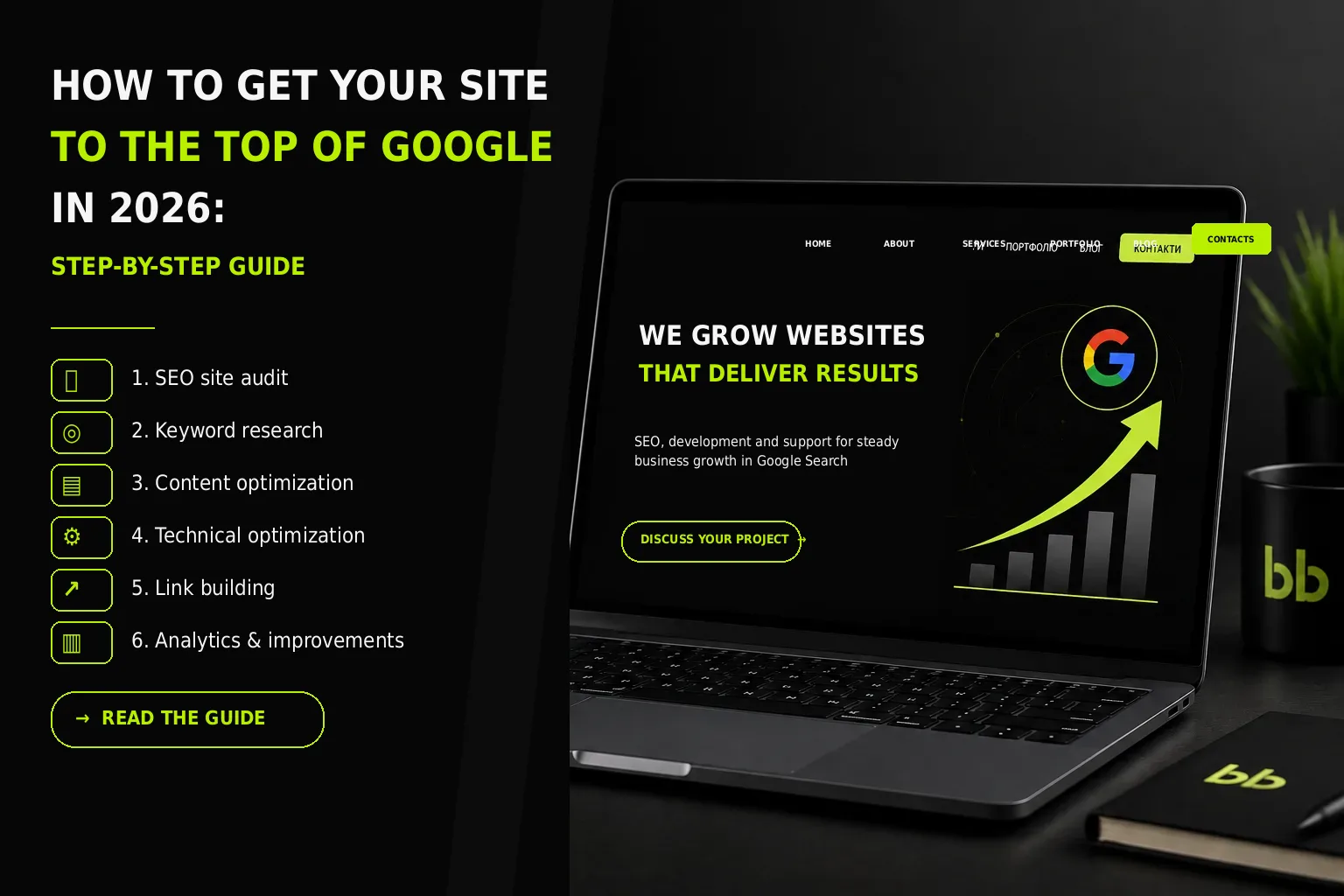
What the top of Google really means today, how long it takes, and the seven steps a site goes through from zero to its first sear…

A website pays for itself not when it “looks good,” but when it generates more gross profit than its development, traffic acquisi…
A bit about us
BB STUDIO is a team that goes beyond the standard approach to web development. We build modern turnkey websites focused on concrete business results: attracting new clients, increasing sales and keeping the project stable after launch.
We deliver the full cycle of building web products — from analytics, strategy and design to launch, technical support and further development. We start every project with a detailed study of the business, company goals, audience needs and market specifics.
We work transparently and consistently, so you can see the progress of the project at every stage.
Discuss a projectDiscuss a projectWe dive into the specifics of your business, research the market and competitors and form a clear technical brief for the future project.
We plan the site architecture, build convenient interaction scenarios and create prototypes of key pages.

We create a modern and recognizable design in your brand style, adapted to all devices and user needs.
We turn the design into a fast, stable and functional website on our own CMS (PHP, JavaScript, Bootstrap) — without plugin bloat. If the project needs WordPress, we build on it too.

We fill the site with content, perform basic SEO optimization and connect CRM, analytics and the necessary services.
We thoroughly check the speed, responsiveness, functionality and correctness of the site before publishing it.
We stay by your side after launch: we provide technical support, updates, improvements and further development of the project.
Everything we agree is put in writing, and we never take money up front — you see the result of the work before you pay for it.
We take no money in advance. Payment terms are agreed with you beforehand — by arrangement or under the contract.
Contract, invoice and certificate of completed work. We are a Ukrainian sole proprietor (FOP, 3rd group) and not VAT-registered, so the price is final — no VAT is added on top.
We fix the scope, cost and timeline before work starts. Any new task begins only after you have approved its price.
The consultation and project estimate cost nothing and commit you to nothing. We reply within 15 minutes during working hours.
We know how a dental clinic website differs from a furniture maker's. Pick your field — you'll find the structure, integrations and pricing built for it:
We build modern websites that combine thoughtful design, high speed and convenient functionality. From corporate sites to complex web projects — solutions that work for your business growth.
We design online stores with a well-thought-out structure, fast performance and convenient checkout. We integrate payment, delivery and everything needed for effective online sales.
We create landing pages that grab attention and motivate action. A thoughtful structure, strong design and conversion focus help you get more leads.
Design for new websites and redesigns of old ones, UX audits, mockups in Figma or Photoshop and pixel-perfect coding. We also create logos and brand identity. We make sure the site is clear to people and brings in leads, not just looks good.
We optimize the site for search engines, improve its visibility in Google and attract the target audience. We work on technical optimization, content and organic traffic growth.
We set up and run ads on Google, Facebook, Instagram and TikTok, and help businesses show up in ChatGPT and AI search answers. A transparent budget, clear reports and prices published on the site.
We run Instagram, Facebook and TikTok for businesses: a content plan, posts, Reels and Stories in one consistent style. We also set up pages from scratch — profile photo, bio, covers, buttons and a link to your site.
We ensure the stable operation of the site: updates, backups, bug fixes, security control and technical support. You grow your business — we take care of the site.
We host websites on fast SSD hosting with SSL, daily backups and 24/7 monitoring. Moving from another host? The migration is free — and you get 2 weeks of hosting as a gift.
 Let’s create something amazing together
