We create digital solutions that work for businesses
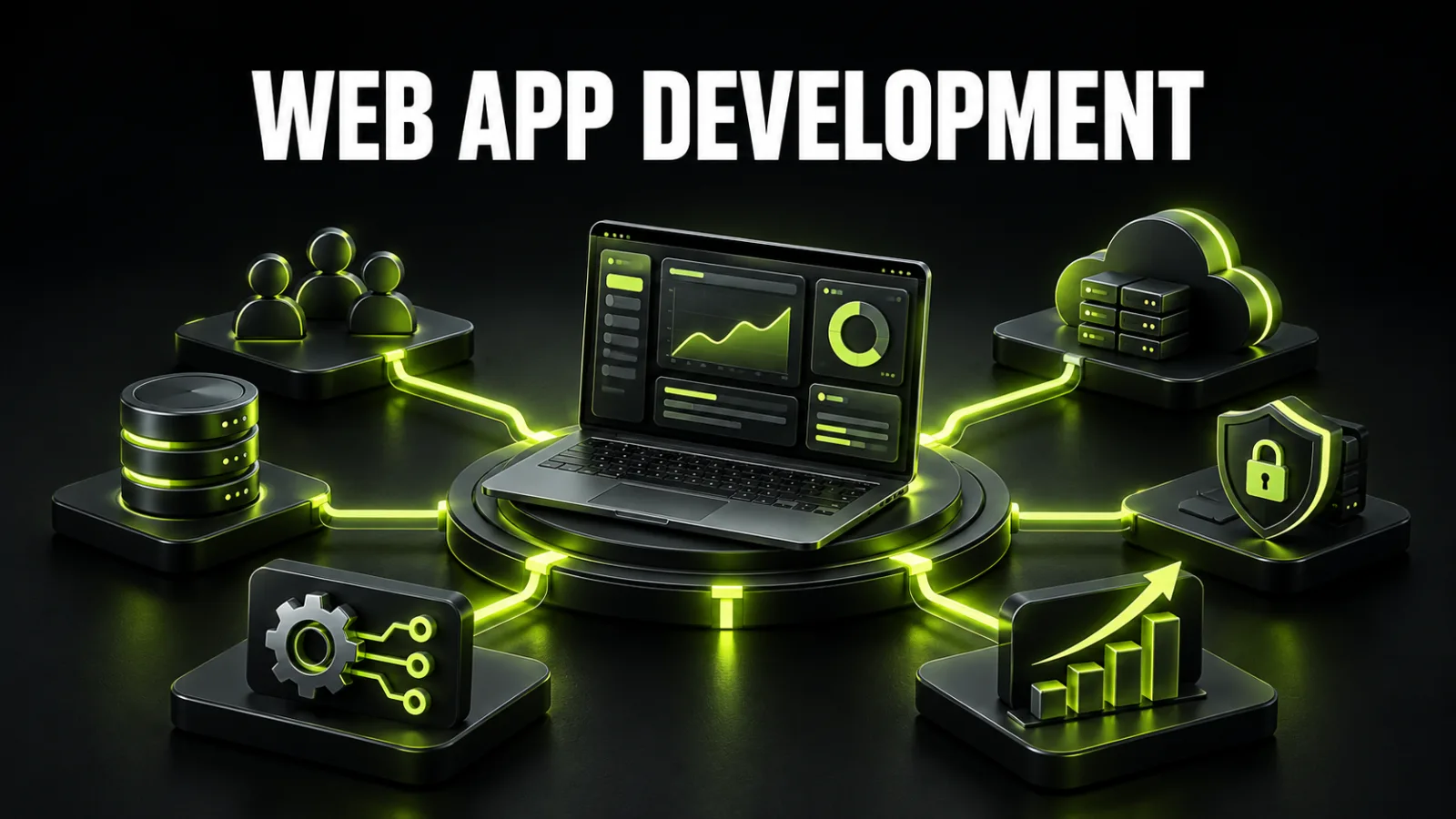
When a website is no longer enough, a business may need a web application: a system where users sign in, work with data, place orders, pay for subscriptions, upload documents, manage a team or complete an end-to-end workflow.
Web applications include SaaS platforms, CRM or ERP modules, B2B portals, marketplaces, booking systems, learning accounts, dashboards, configurators and internal business tools. They open in a browser, but their logic is closer to a software product than to a collection of pages.
The common planning mistake is asking for a quote from a short screen list. Screens do not determine the real scope. Roles, journeys, rules, data, integrations, risk and expected load do. This guide explains how to plan the product and avoid uncontrolled budget growth.
Custom web application development has eight core parts: discovery, role and journey definition, prototyping, UI/UX design, architecture, engineering, quality assurance and launch with ongoing support.
A focused MVP at BB STUDIO can start near the custom web-project baseline of UAH 59,900. A portal with several roles, payments, documents and integrations needs a separate estimate and typically moves into a higher range. A first release may take several weeks or several months depending on the scope.
Before development begins, define one measurable value loop, limit the first release, write acceptance criteria and agree who owns the code, design, infrastructure and service accounts.
A web application is a software system delivered through a browser in which users interact with data and business logic. A normal website primarily presents information and collects a simple enquiry. A web app lets the user perform a sequence of operations whose result is stored, changes status and affects other participants.
Examples include:
The public marketing layer can still use a conventional business website development approach, while the authenticated product requires separate state, permission, data and security design.
| Criterion | Website | Web application | Mobile app |
|---|---|---|---|
| Primary purpose | content, trust, leads and SEO | workflows and data | frequent use with device capabilities |
| User account | optional | usually required | usually required |
| Business logic | simple to moderate | complex, role- and status-based | simple to complex |
| Access | any browser | desktop and mobile browser | installed from an app store |
| Updates | immediate on the server | immediate on the server | often requires store review |
| SEO | important | important for public pages | limited for private screens |
| Offline/device features | limited | partial through PWA | broadest access |
| Starting cost | usually lower | depends on logic | often higher across platforms |
A PWA can support installation, caching, partial offline behavior, push and a standalone appearance. It does not automatically provide all native iOS or Android capabilities, and it cannot compensate for weak product design.
Customers see orders, invoices, documents, rewards, messages and support history. A portal reduces repetitive requests and gives people a transparent status.
Partners access customer-specific prices, stock, contracts, orders, limits and documents. Permissions, approval chains, ERP integration and audit history are central.
One product serves many companies or teams through subscriptions. It needs tenant data isolation, plans, billing, users, feature limits, onboarding, usage metrics and support operations.
A marketplace connects buyers, sellers, specialists or suppliers. The product adds moderation, commissions, payouts, disputes, ratings, participant verification and multi-party order flows.
Examples include production planning, a field-team portal, document workflow, estimating or operational dashboards. The value is lower manual effort, fewer mistakes and less duplicated data rather than public traffic.
Booking requires calendars, resources, slots, payment, refunds and reminders. Learning platforms require courses, progress, permissions, tests, certificates and instructor roles.
Build a custom application when off-the-shelf software does not support a critical process or forces the team to repeat costly manual work. Strong signals include:
Custom code is not automatically the best answer. If a CRM, CMS, no-code platform or existing SaaS covers 80–90% of the requirement without a critical constraint, configure that solution and validate the process first.
The browser interface includes forms, tables, filters, dashboards, notifications, responsive states and interaction logic. It must handle loading, empty results, errors, lost connectivity and insufficient permissions — not only the ideal happy path.
The server validates rules, reads and writes data, controls statuses, payment, notifications, files and integrations. Critical decisions must not exist only in browser code that a user can manipulate.
The data model connects users, organisations, orders, documents, payments and events. Early modelling mistakes make reporting, migration and scaling harder.
The business team should manage users, content, statuses, reference data, plans and failed operations without a developer. Administrator permissions need their own role model.
Payments, CRM, ERP, delivery, email, SMS, telephony, analytics, documents and identity are commonly connected through APIs. Each integration needs error handling, retries, limits, logs and a manual recovery path.
Development, staging and production environments, domain, TLS, compute, database, file storage, backups, logging, monitoring and deployment are product scope, not post-coding chores.
Answer five questions before choosing technology or drawing finished screens:
A B2B portal goal should be more specific than “digitise sales.” A stronger goal is reducing a repeat order from 30 minutes to five while lowering manual price errors.
For an unvalidated product, separate the first experiment into an MVP development plan. This guide covers the full application lifecycle, while the MVP process prevents the first release from becoming a complete wish list.
A page list does not define an application. Roles and user flows do.
A B2B system might include:
For each role, document what it can view, create, edit, approve, export and delete. Also cover invitations, blocking, role changes, account recovery and employee offboarding.
A specification should remove ambiguity rather than create bureaucracy. The guide to a website technical specification provides a reusable structure for roles, flows, functions and acceptance criteria.
A prototype demonstrates actions, information, states and transitions rather than visual polish. Each critical journey needs:
A complex desktop table cannot simply shrink onto a phone. Decide whether mobile users need summary cards, filters, approvals or the complete workflow.
Professional UI/UX design should include a component system and important states so engineers do not invent interface rules while coding.
Choose technology after the requirements, not from a popularity chart. Consider:
A common stack may combine React, Vue or server-rendered templates on the front end; Laravel, Node.js, Python, .NET or another back-end platform; PostgreSQL or another database; object storage, queues, caching, containers and cloud infrastructure. The technology name alone does not guarantee good architecture.
A CMS may own public marketing content while custom business logic runs in a separate module or service. This hybrid model is often faster and less expensive than rebuilding every content function.
The team studies the workflow, users, constraints, data, integrations and success metrics. The output is a first-release boundary, journey map, risk list and initial estimate.
Requirements become features, user stories, acceptance criteria and priorities. Large capabilities are divided across releases.
Critical journeys are tested before high-fidelity design and code. Missing steps are cheaper to fix here.
The team creates components, responsive states, tables, forms, notifications and visual hierarchy rules.
Modules, data model, APIs, permissions, integrations, logs, recovery and deployment pipelines are defined.
Work proceeds in short iterations with demonstrations of completed journeys. Code review, automated checks and developer testing run continuously.
Functions, roles, browsers, mobile devices, accessibility, integrations, concurrent operations, imports, failure paths and recovery are tested. Critical products add a security review and load testing.
A limited group of real users tests the application. After fixes, the team migrates data, trains users, launches production and starts monitoring and support.
Security is not a plugin installed before launch. It begins with a threat and data model.
The practical baseline includes:
OWASP ASVS can be used as a source of testable technical security requirements rather than a marketing badge.
Web-app performance is more than initial load time. Table interactions, search, filtering, batch actions and saves must remain responsive. Measure browser work, server latency, slow database queries and third-party APIs.
Use Core Web Vitals for public routes and business-operation timings for authenticated workflows. Important events and failures should reach analytics and observability systems.
Design accessibility into components using WCAG 2.2: visible focus, keyboard operation, labels, error messages, contrast, zoom, logical order and accessible authentication. Retrofitting hundreds of screens is much more expensive.
The current BB STUDIO starting point for a custom web project is UAH 59,900. It is not a fixed SaaS or portal price, but a baseline for a tightly scoped first release. Current commercial starting points are available on the BB STUDIO pricing page.
Planning scenarios:
| Product | Indicative budget | Typical scope |
|---|---|---|
| Focused web-product MVP | UAH 59,900–120,000 | one value loop, basic roles, simple account, few integrations |
| Customer portal or internal tool | UAH 120,000–300,000 | several roles, documents, statuses, reports, 2–4 integrations |
| First B2B portal or SaaS release | UAH 250,000–600,000 | organisations, teams, plans, billing, permissions and audit |
| Marketplace or high-load platform | from UAH 400,000 | multiple parties, payments, commissions, moderation and scaling |
These ranges are not a public offer. A “customer portal” can mean three screens or dozens of processes.
Typical planning ranges are:
Some work runs in parallel, so the ranges should not simply be added. Scope changes, undefined business rules, difficult integrations, missing test data and slow approvals are common causes of delay.
One total price hides the delivery model. Ask each supplier to separate:
The guide on ordering a website or web project explains briefing, contracts, payment, ownership and acceptance.
Make sure the business receives the repository, designs, documentation, cloud access, domain, analytics and integration accounts. Review the BB STUDIO portfolio and ask about the problem, logic and result behind a relevant project — not only its appearance.
A web application is not finished at production release. Real data reveals unplanned journeys, integration issues and optimisation opportunities.
The development loop is:
Ongoing website and application support should cover logs, recovery, security, performance and a predictable release process, not only dependency updates.
A web application is justified when it performs a process, reduces manual work, creates a revenue channel or enables customer self-service. Quality depends less on a fashionable stack or screen count than on complete journeys, correct roles, reliable data, security, measurable outcomes and a maintainable product.
Start with the problem and one value loop. Then define the first release, prototype, acceptance criteria, architecture and post-launch plan. To receive an initial structure, delivery stages and estimate for your product, contact BB STUDIO.
 Web development
 CRM and Business Automation
 Web development
 For business
 Let’s create something amazing together
