We create digital solutions that work for businesses
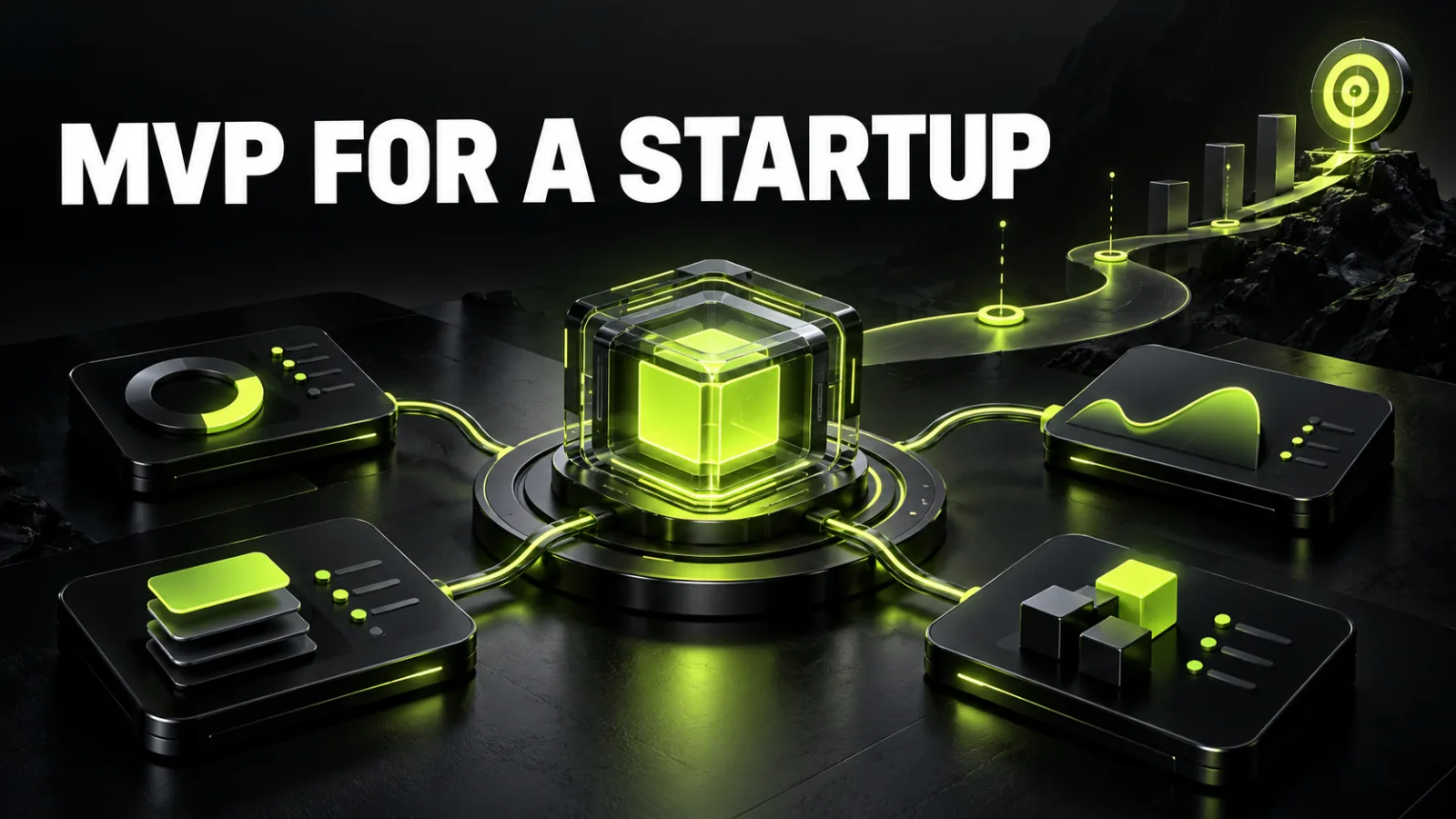
A founder describes a platform and quickly adds accounts, subscriptions, chat, ratings, referrals, a mobile app, several user roles, and advanced reporting. Months later, the budget is shrinking, but the team still cannot answer the most important question: do customers care enough about the problem to change behaviour and pay for a solution?
An MVP reverses that sequence. The team identifies the riskiest assumption, creates the smallest complete experience that can test it, puts it in front of real users, and expands only after learning. The objective is not to build less at any cost. It is to obtain reliable evidence before making the next investment.
This guide explains how an MVP differs from a prototype or landing page, when code is unnecessary, how to prioritise features, plan cost and delivery, and decide whether to scale, iterate, pivot, or stop.
An MVP, or minimum viable product, is the smallest working version that:
Minimum limits the scope. Viable means the solution is useful and reliable enough for the promised task. Product means a complete experience rather than a collection of screens that only works during a founder-led demonstration.
An MVP for meeting-room booking might support one location, availability, booking, and confirmation. Loyalty, complex pricing, access-control integration, and native mobile apps can wait. Double booking, exposed data, and missing confirmations cannot be dismissed as “minimal.”
Professional website and web product development should begin with the user problem, business model, and validation criterion rather than a fashionable technology list.
| Format | What it tests | Main users | Code required? |
|---|---|---|---|
| Interviews and research | whether the problem exists and how people solve it today | potential customers | no |
| Prototype | whether the flow and interface are understandable | research participants and team | usually no |
| Proof of concept | whether a technical approach is feasible | technical team or partner | sometimes |
| Landing page / smoke test | whether the proposition attracts intent | campaign audience | minimal |
| Concierge MVP | whether value exists when part of delivery is manual | early customers | partly |
| Pilot | whether the product works in a specific company or segment | limited group | yes |
| MVP | whether real users adopt and pay for the core value | early market | depends on the model |
A prototype does not need production data or reliability. A PoC can prove technology without proving demand. A landing page measures interest but not repeated use. An MVP combines a real journey, value delivery, and measurement.
Not every idea needs software immediately. The right first experiment may be a focused landing page, ten customer interviews, a paid manual pilot, or a workflow assembled from existing tools.
Use an MVP when:
An MVP cannot rescue a weak problem, impossible economics, or a team unwilling to talk to customers. If every negative result is explained as “users did not understand,” development will only make the assumption more expensive.
Before development, answer five questions:
If the answers come only from the founding team, conduct problem interviews. Ask about the most recent real event, tools used, people involved, workarounds, and consequences. Avoid explaining the solution too early.
Then validate intent with a cheaper format:
“Great idea” is weak evidence. A stronger signal has a cost: a prospect shares operational data, schedules their team, signs a pilot agreement, introduces a decision-maker, or pays.
A startup depends on many beliefs:
Choose the assumption whose failure would invalidate the project. For a marketplace, supply may be the risk. For SaaS, it may be recurring usage and willingness to subscribe. For an AI tool, it may be accuracy on real data rather than a polished interface.
Use a testable statement:
We believe [segment] experiences [problem] and will use [core journey] to achieve [outcome]. We will consider this supported if, within [period], we observe [measurable behaviour].
For example: “Small cleaning companies spend time manually assigning jobs. Within four weeks, at least five of ten pilot teams will create 20 or more assignments and return the following week.”
Scope becomes manageable when the team chooses one primary segment and one complete loop.
Weak: “A platform for every professional to communicate, learn, sell services, and find work.”
Stronger: “A dispatch tool for small repair teams that receives an enquiry, assigns a technician, and shows the customer a status.”
A core value loop usually includes:
Anything that does not enable this loop, keep it safe, or measure it is a candidate for later.
Describe the outcome without premature interface detail: “A store owner connects a catalogue, sees out-of-stock products, assigns corrections, and receives a completion report.”
List what happens before entry, during setup, at the moment of value, and afterward. Mark manual steps, system steps, dependencies, errors, and decisions.
| Level | Rule | Example |
|---|---|---|
| Must | required for the value loop, security, or measurement | sign-in, job creation, status, error log |
| Should | materially improves the experience but has a temporary workaround | CSV import before real-time API sync |
| Later | supports scale, another segment, or optimisation | referrals, advanced customisation |
“User account exists” is ambiguous. A better requirement is: “An invited user sets a password, signs in, sees only authorised projects, and can restore access through a verified email address.”
Roles, states, integrations, and acceptance rules belong in a compact but clear website technical specification. MVP scope may be small; ambiguity should not be.
Collect only necessary data, state the purpose, define retention, and provide a deletion path. Health, financial, identity, or other sensitive information may change architecture, vendor selection, and legal obligations before an MVP is built.
Keyboard operation, field labels, contrast, visible focus, understandable errors, and responsive layouts are not luxury features. They determine whether users can complete the core journey.
A payment must not create duplicate orders, a repeated webhook must not duplicate a business event, and a temporary CRM outage must not erase an enquiry. A product can be narrow while keeping its core promise reliable.
A prototype helps repair the journey before engineering. Cover:
An MVP does not require elaborate motion or dozens of bespoke templates. It does require a coherent interface that users can understand and trust. Otherwise the team may reject a valuable hypothesis because the experience itself was confusing. BB STUDIO UI/UX design helps validate flows before implementation consumes the larger share of the budget.
Useful for internal dashboards, small catalogues, forms, simple workflows, and low-volume pilots. It accelerates launch but may limit logic, performance, export, pricing predictability, and platform independence.
Suitable for content-led sites, standard stores, directories, or booking flows. Avoid building a critical product from many unsupported plugins without an update, security, and ownership plan.
Appropriate for SaaS, marketplaces, complex roles, proprietary logic, configurators, special integrations, or serious scaling requirements. It costs more initially but avoids forcing the business around a platform’s hard limits.
Choose according to user journeys, data, integrations, risk, future ownership, and total cost—not technology fashion.
Measurement belongs in scope from the start. Without it, the result is a collection of opinions.
Select one primary test metric and a few guardrails. A shorter signup may increase activation while also creating low-quality accounts or additional support cost.
An MVP does not have to automate every process. If the team can manually prepare a report for the first ten customers, it can validate usefulness before investing in a complex generator. Be transparent and ensure the manual process is controlled.
Automate early where failure risks money, data, or trust: payments, access rights, order persistence, backups, error alerts, and retry logic. When enquiries must enter a sales process, plan CRM website integration with attribution and failure recovery rather than treating email as the system of record.
There is no universal price. A landing page with a manual pilot, a B2B portal, and a two-sided marketplace are different products.
Cost depends on:
At the time of writing, BB STUDIO lists custom projects from UAH 59,900. This is not a fixed price for every MVP. A landing-page test can cost less, while a marketplace or SaaS platform can require substantially more. Current starting points are available on the BB STUDIO pricing page.
Estimate the first measurable release separately from the post-validation roadmap.
Problem research and prototyping may take days or weeks. Development time depends on the scope. A simple pilot can be launched quickly, while roles, payments, integrations, and sensitive data require architecture, quality assurance, and infrastructure preparation.
Split the timeline into visible outcomes:
Compare suppliers by deliverables, acceptance criteria, ownership, and support—not by one final number. The guide on ordering a website for your business explains how to structure stages and approve work.
Must: company, manager and worker roles; task creation; assignment; status; notification; audit history; basic report.
Later: route optimisation, native app, payroll, workload forecasting.
Must: one service segment; profile; request; review after a verified job; manual moderation; basic fee model.
Later: many categories, automatic matching, complex rating, loyalty.
Must: authentication, authorised catalogue, customer pricing, order creation, history, status, and export.
Later: multi-step approval, credit limits, demand forecasting, multi-warehouse logic.
Must: one document type, secure upload, extraction of defined fields, human review, export, and measured accuracy.
Later: many formats, autonomous decisions, generative reporting, broad integrations.
Early users should belong to the target segment, experience the real problem, and be willing to provide concrete feedback. Supportive friends rarely reproduce genuine payment behaviour.
For a closed pilot:
“What should we add?” produces wish lists. Ask instead: “What were you trying to do?”, “Where did you stop?”, “What did you do instead?”, and “What outcome did you expect?”
Users complete the core loop, return, pay, or invite others. The roadmap now addresses demonstrated constraints such as automation, performance, integrations, and expansion to a second segment.
The problem matters, but the journey or proposition does not work. Change one major element—segment, onboarding, value format, price, or channel—and test again.
Evidence reveals a stronger problem, audience, or side feature. A pivot is a new testable hypothesis based on data, not random idea switching.
If users do not experience the pain, complete the journey, or show willingness to pay, stopping protects future capital. That is a useful validation result, not a technical failure.
After launch, the product needs monitoring, backups, error fixes, and integration checks. Website support and maintenance helps the team improve the MVP without allowing critical technical debt to accumulate unnoticed.
An MVP is a learning instrument delivered through a real product, not an excuse for low quality. Its strength comes from discipline: one audience, one meaningful problem, one complete value loop, and a criterion for the next decision.
Use the cheapest credible experiment first. If interviews, a landing page, or a manual pilot can test the risk, do not write custom software prematurely. When a web product is required, define scope, analytics, safety, and acceptance. After launch, evaluate behaviour, retention, payment, and economics rather than compliments.
To turn an idea into a testable journey, prototype, technical plan, and staged estimate, contact BB STUDIO.
 Analytics and Conversion
 E-commerce
 Google Ads
 For business
 Let’s create something amazing together
