We create digital solutions that work for businesses
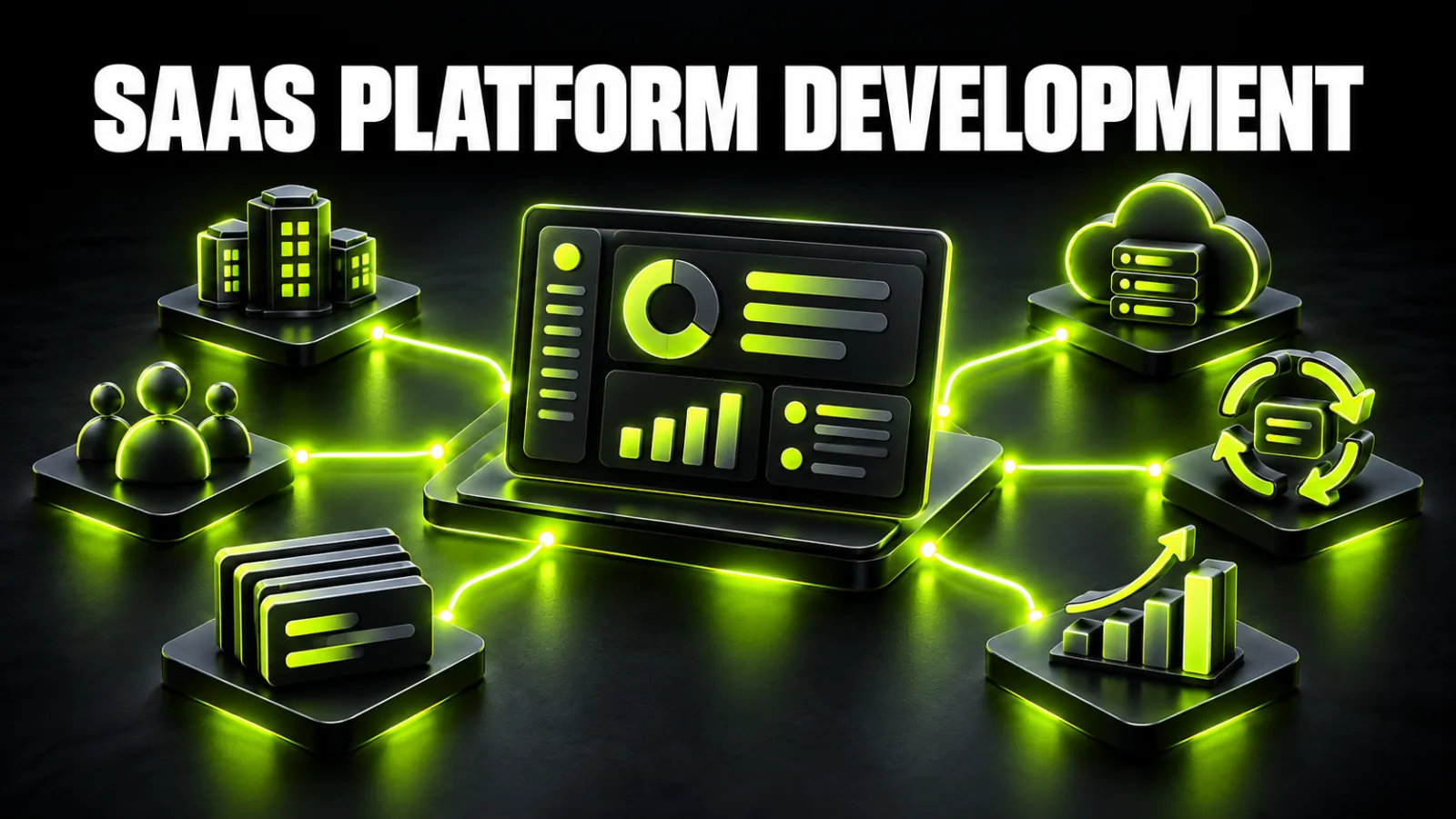
SaaS gives customers access to software through a browser in exchange for a subscription or recurring payment. The provider does not sell one copy and finish the project at launch. It continuously operates the platform, ships improvements, protects data and proves value during every billing period.
CRM systems, analytics tools, planners, document services, marketing platforms, learning products and industry-specific B2B tools follow this model. One platform may serve dozens or thousands of organisations, while every company’s data, roles, settings and plan remain isolated.
SaaS development combines product strategy, recurring-revenue economics and a complex technical system. For the broader architecture and product lifecycle, see our guide to web application development for business. This article focuses on what makes SaaS different from an ordinary web service.
Building a SaaS platform requires seven connected steps: identify a repeated problem, confirm willingness to pay, choose a segment and pricing model, design the smallest value journey, build a secure multi-tenant system, run a controlled pilot and develop the product using adoption and retention data.
The first version should not automate everything. It must take the user from sign-up to one measurable outcome. In a CRM, that could be the first completed deal; in reporting software, the first useful report; in a planner, the first completed team cycle.
A focused custom SaaS MVP often requires UAH 120,000–250,000. A commercial product with teams, roles, plans, subscription billing, notifications and several integrations can require UAH 250,000–600,000 or more. Discovery is needed for an accurate estimate.
SaaS means software as a service. Users do not install their own server copy or purchase a perpetual licence. They access a centrally operated cloud system, while the provider manages infrastructure, updates, availability and security.
Common SaaS characteristics include:
Not every customer portal is SaaS. A portal usually serves customers of one company, while SaaS is a standalone product used by multiple organisations or independent users. The first model is covered in our customer portal development guide.
A weak SaaS idea sounds like “a CRM for everyone” or “an AI-powered platform.” A strong idea defines a group, a repeated job and a measurable result.
Examples:
Before development, interview one segment, observe the current workflow, estimate problem frequency and quantify the cost of doing nothing. The critical question is whether a customer will change behaviour and pay regularly for a better outcome.
Pricing should follow customer value. A feature-based plan may be clear to developers but not to buyers.
Suitable for collaborative software whose value grows with team size, such as CRM, project management, HR and support. The risk is that customers restrict access or share accounts.
Plans differ by limits, functions, integrations and support. They are easy to explain, but too many small restrictions make comparison difficult.
Customers pay per transaction, document, minute, request, storage unit or computation. It works for variable demand, but the bill must remain predictable.
A base subscription is combined with usage overages, add-ons or premium support. This is often flexible for B2B products.
A free plan lowers the entry barrier but creates infrastructure and support costs. A trial works only when the user reaches value before it ends.
Registrations alone do not describe a SaaS business. The product must show whether users reach an outcome, return and pay.
Important metrics include:
Analytics events should mirror the product journey: workspace created, colleague invited, data imported, first workflow completed, return visit and payment conversion.
Users create an account, verify contact details, create an organisation, choose a goal, import data and complete the first useful action. Every unnecessary step reduces activation.
One person may belong to several companies, while an organisation may have owners, administrators and members. The system needs invitations, role changes, ownership transfer, suspension and deletion.
Access may depend on role, organisation, plan and resource. B2B products often need custom client roles and audit logs for sensitive actions.
The platform manages trials, payments, invoices, plan changes, proration, discounts, failed payments, retries and access recovery.
This is why the product exists: deals, documents, projects, bookings, reports, campaigns or another complete process. It should work exceptionally well rather than disappear among secondary features.
The SaaS team needs visibility into customers, plans, billing, usage, errors, support and suspicious activity. Safe support tools are better than direct database edits.
Email, SMS, push and in-product messages support onboarding, invitations, critical events, billing and re-engagement. Communication should be useful rather than noisy.
CRM, payments, analytics, documents, calendars, email, webhooks and exports place the product inside the customer workflow. Every integration needs retries, logs and failure handling.
One SaaS platform serves many customers, or tenants. Each tenant can have its own users, settings, data, plan and integrations.
The central rule is that a request from one customer must never return another customer’s data. Organisation scope is validated on the server for every operation rather than trusted from the browser.
Common data strategies include:
Shared models reduce early cost and simplify mass updates. Separate databases provide stronger isolation but complicate migrations, monitoring and operations. The right choice depends on data risk, scale, client requirements and team capacity.
A SaaS interface should teach through action. A long tooltip tour cannot compensate for weak structure or a missing first outcome.
During SaaS UI/UX design, cover:
Do not greet new users with a dashboard full of zeros. A template, demo data or short setup flow should lead them to value.
A SaaS provider is responsible for many customers’ data. One access-control mistake can affect the entire product.
Baseline requirements include:
Reliability also means correct behaviour when a billing provider is unavailable, a webhook is delayed or repeated, or an integration fails halfway through a workflow.
An MVP is not a cheap miniature of the future platform. It is the smallest version that proves one segment receives value and will pay.
The first release may contain:
Automated billing, many plans, white label, an integration marketplace and advanced reporting can follow demand validation. The practical validation sequence is explained in our startup MVP guide.
Define the user, problem, alternatives, budget, buying process and success criterion. The outcome is a prioritised risk and hypothesis list rather than a presentation of the idea.
Document the first customer outcome, MVP scope, limits and payment mechanism. Check whether the pricing metric reflects value.
Representatives of the target segment complete a clickable flow while the team observes rather than explains every step.
Describe the tenant model, roles, data, APIs, integrations, billing, events, acceptance criteria and non-functional requirements.
Plan the database, services, queues, storage, environments, logs, components and responsive states.
Every sprint delivers a working journey. Features are tested on staging before production.
Early customers use the product with close support. Some operations may remain manual to validate the model faster.
Introduce stable billing, documentation, support, onboarding, monitoring, policies and a release process.
The roadmap follows activation data, support requests, churn reasons and paid-segment needs rather than the longest feature list.
For unique product logic, custom website and web app development connects product strategy, UX and architecture in one delivery process.
The ranges below support early planning and are not a public offer.
| Scenario | Typical scope | Planning range |
|---|---|---|
| Validation prototype | research, user flows, clickable prototype and testing | UAH 40,000–90,000 |
| Focused SaaS MVP | one segment, core journey, organisations, basic roles and administration | UAH 120,000–250,000 |
| Commercial SaaS | plans, billing, teams, integrations, analytics and support tools | UAH 250,000–600,000 |
| Advanced B2B platform | detailed permissions, audit, SSO, many integrations and high requirements | from UAH 600,000 |
Complex data, flexible permissions, usage billing, migration, white label, native mobile apps, real-time features, scale and compliance requirements increase cost.
BB STUDIO’s custom web project baseline starts at UAH 59,900, but a complete SaaS is normally broader than a basic web service. Current starting figures are available on the development pricing page.
Discovery and prototyping may take 2–5 weeks. A focused MVP may take 2–4 months. A commercial release with billing, roles and integrations can require 4–9 months. Advanced B2B SaaS is normally released in stages and continues to evolve.
Timeline depends on decision speed, subject-matter access, external APIs, data readiness, roles and priority changes.
Even a focused SaaS needs several capabilities:
People may combine roles early, but responsibility must remain explicit. If nobody owns onboarding or retention, those problems will not resolve themselves.
Find early customers before spending heavily on acquisition. They validate the workflow, language, pricing, support and actual value.
A practical pilot:
Free users may provide many ideas, but paying customers are a stronger signal for value and priority.
Launch begins the operating phase: support, updates, security, infrastructure cost optimisation, churn analysis and regular releases.
Monitor:
Ownership and response times should be defined before launch through an ongoing product support plan.
Ask the team to explain:
When reviewing a web development portfolio, consider workflow complexity, responsiveness, integrations and delivery quality as well as visual design.
SaaS does not begin with a subscription screen or a technology stack. It begins with a repeated problem that a specific segment will pay to solve continuously.
The first release should deliver one result quickly, isolate organisation data safely and collect meaningful product events. Once value is proven, the platform can expand into automated billing, plans, integrations, advanced roles and scale.
Prepare a short description of the segment, current workflow, core journey and pricing model, then discuss your SaaS project with BB STUDIO.
 Web Application Development
 Web Application Development
 E-commerce
 SEO
 Let’s create something amazing together

