We create digital solutions that work for businesses
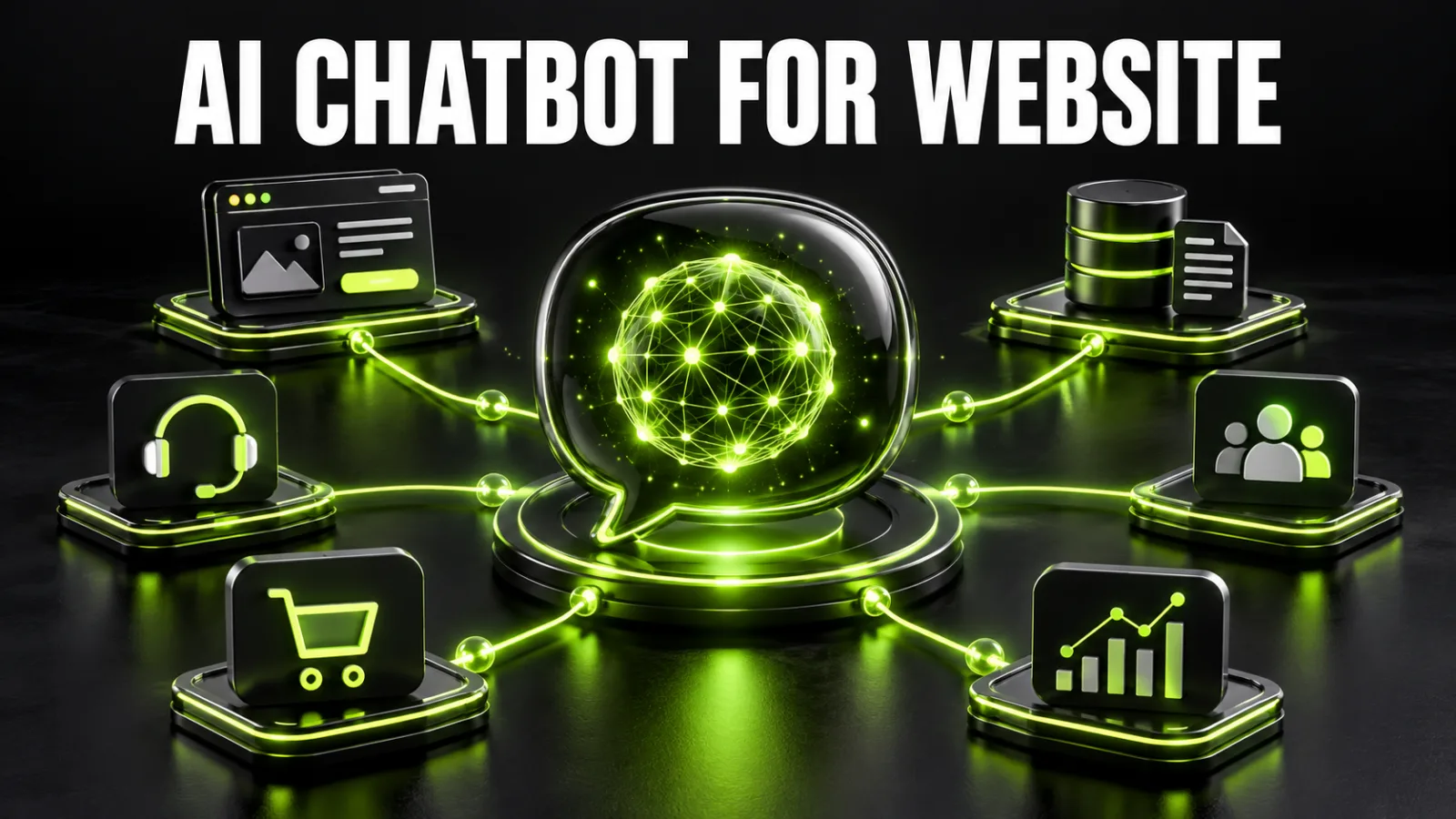
An AI chatbot can answer questions about services and products, retrieve information from a knowledge base, clarify customer needs, collect contact details, and hand a complex conversation to a person. Unlike a traditional button-based bot, it can understand different phrasings and produce a natural-language answer.
Connecting a language model, however, does not create a reliable business service by itself. The system needs approved sources, response boundaries, personal-data rules, controlled access to company systems, and a fast human handoff. The broader guide to AI for business covers general use cases; this article focuses specifically on a website chatbot.
An AI chatbot is a software interface that receives a visitor's message, determines intent, retrieves relevant information, and produces an answer. Depending on its architecture, it may only answer from a knowledge base or perform approved actions through integrations—for example, check an order, create an enquiry, recommend a product, or transfer the conversation to an agent.
Three components should be distinguished:
| Component | Function | Example |
|---|---|---|
| Interface | displays the chat and receives messages | website widget |
| AI layer | identifies intent and prepares the response | language model and instructions |
| Data and actions | provide facts and execute operations | knowledge base, CRM, catalog, API |
Without verified sources, a chatbot may rely on general model knowledge and invent details. The core business asset is therefore not the widget animation but a governed system of data, access, and rules.
| Criterion | Rule-based bot | AI chatbot |
|---|---|---|
| Interaction | buttons and predefined branches | free-form questions |
| Answers | written in advance | generated from approved sources |
| Unexpected requests | often break the flow | may be classified or clarified |
| Maintenance | edit each branch | update knowledge, rules, and tests |
| Risks | dead-end journeys | inaccurate output, data exposure, prompt injection |
| Best fit | a simple form or menu | many questions expressed in different ways |
A rule-based bot remains appropriate when the goal is to ask five questions and forward a form. AI becomes useful when customers ask diverse questions whose answers live in documents, a catalog, or company systems. A hybrid often works best: the model handles natural conversation while critical steps use controlled buttons and validated forms.
The bot can explain service conditions, processes, delivery, payment, returns, documentation, and product use. Every answer should be grounded in a current approved source.
A few clarifying questions can identify the project type, timing, budget range, and desired outcome. The bot can then recommend a relevant page or collect an enquiry. This journey depends on the service architecture and should be planned together with website development.
An ecommerce assistant may find products by purpose, specification, compatibility, and availability. The answer must come from the current catalog rather than model memory. Categories, filters, and attributes should be designed during online-store development.
The bot can collect need, geography, timeline, and preferred contact method. It should not infer protected characteristics, discriminate, or permanently reject a prospect without human review.
When a question exceeds approved knowledge, the customer is frustrated, or a decision requires human authority, the chatbot should create a concise summary and send the full context to an agent.
With an approved integration, the bot may retrieve an order, explain status, provide instructions, or open a support ticket. Access to personal information requires proper authentication, not merely an order number typed into a public chat.
The investment is more likely to make sense when:
enquiry volume is high enough to create measurable savings;
questions repeat but are phrased differently;
the company has current sources of truth;
employees spend material time on initial consultations;
mistakes can be detected before a high-impact action;
someone owns the knowledge and quality process;
the business will review conversations and improve the system.
If a website receives little relevant traffic, a chatbot will not solve the demand problem. First build a sound plan for getting customers for a small business and identify the acquisition sources. Stable organic acquisition also requires systematic SEO services.
A typical request follows this sequence:
The visitor sends a message.
The system applies technical limits and safety checks.
A classifier identifies intent, language, and approximate risk.
Retrieval finds relevant passages in approved knowledge.
The model composes an answer from the instructions and evidence.
Output checks validate format, citations, and prohibited claims.
The chatbot answers, asks a question, or escalates.
An event is recorded for analytics and quality review.
This pattern is commonly called retrieval-augmented generation, or RAG. It supplies the model with relevant passages from a separate source. RAG reduces dependence on general model knowledge but cannot eliminate error. An outdated policy, poor document, or irrelevant passage may still produce a wrong answer.
Knowledge may include service pages, FAQs, product records, guides, delivery and return terms, policies, and approved answer templates. Contradictions need to be resolved before indexing.
For every source, store:
title and content type;
responsible owner;
last review date;
language and region;
access level;
validity period;
related product or service;
canonical source link.
One topic should not have three competing “current” answers. When conditions differ by market or customer type, that distinction must be explicit in the metadata and content.
The chatbot may create a contact, opportunity, or task and attach the conversation summary and source. Required fields, consent, and duplicates should be checked before writing data.
The system can retrieve current prices, availability, attributes, or status. The model must not change source records or invent missing values.
A conversation may become a ticket with category, priority, and transcript. Priority should follow defined rules rather than an emotional guess made by the model.
Any action involving payment, addresses, accounts, or personal data needs strong authentication and explicit confirmation. A chatbot should never reveal sensitive data merely because someone knows a name or phone number.
Track widget opens, conversations, identified intents, grounded answers, failures, handoffs, and enquiries. The event model should align with Google Analytics 4 setup.
A good chatbot should not pretend to be a person. Its introduction should describe what it can do and provide an obvious path to a human.
Define the following for each intent:
| Element | Example decision |
|---|---|
| Objective | answer a question or collect an enquiry |
| Required data | service type, city, timing |
| Allowed sources | named documents or APIs |
| Prohibited claims | guarantees or legal conclusions |
| Clarification | question to ask when data is missing |
| Escalation | conditions for human handoff |
| Success | answer confirmed or enquiry created |
Ask one clear question at a time. A long questionnaire performs poorly inside a chat. When many validated fields are required, the bot should open a suitable form.
Escalate when:
the visitor asks for an agent;
the knowledge base does not support an answer;
retrieval confidence is low;
the conversation contains a complaint, conflict, or risk;
the request involves payment, personal data, or a legal decision;
an integration returns an error;
the dialogue repeats without progress.
The agent should receive the original message, a concise summary, identified intent, referenced sources, and collected details. After the case is resolved, the agent can label whether the bot response was useful. Those labels become improvement data.
Prompt injection is an attempt to change system behaviour through user text or retrieved content—for example, instructing the bot to ignore rules, expose hidden instructions, or access private data. A system prompt that says “never reveal secrets” is not sufficient protection.
A practical control set includes:
least privilege for every integration;
separation of public and restricted knowledge;
authentication before access to personal data;
allow-listed actions and parameters;
human approval for high-impact actions;
input and output validation;
rate and message-size limits;
logs that avoid unnecessary sensitive data;
adversarial and prompt-injection testing;
a fast kill switch for the bot and integrations.
Do not send passwords, API secrets, full payment details, or irrelevant personal information to the model. Define retention, processing purpose, and user notice before launch.
Reliability is built in layers:
Keep only current approved sources.
Restrict retrieval by topic, access, market, and language.
Require the response to cite its source.
When confidence is low, clarify or escalate instead of guessing.
Retrieve price, stock, and status through an API.
Block or escalate high-risk topics.
Run the test set after every material update.
An honest “I cannot verify that; I will transfer you to an agent” is more useful than a confident wrong answer.
There is no single price because the term covers very different systems.
| Level | Included | Main cost drivers |
|---|---|---|
| Hosted service | widget, basic flows, FAQ import | platform plan, setup, content |
| Knowledge chatbot | company documents, retrieval, sources, analytics, handoff | discovery, data preparation, integration, testing |
| Custom system | CRM, catalog, accounts, API actions, roles, audit trail | development, infrastructure, security, support |
The budget is primarily affected by:
number of use cases and languages;
volume and quality of the source material;
CRM, ERP, catalog, or helpdesk integrations;
user authentication;
actions the chatbot may perform;
traffic and model usage;
retention, audit, and data-region requirements;
custom widget design;
security testing;
ongoing monitoring and updates.
A responsible estimate follows a short discovery covering the objective, channels, data, risks, integrations, expected traffic, and success criteria. A final quote based only on “we need an AI chatbot” will almost certainly omit requirements.
The operational budget may include:
platform plan or hosting;
model and retrieval usage;
data and log storage;
error monitoring;
knowledge-base updates;
integration maintenance;
quality and security reviews.
These activities may form part of regular website support. Without an owner, even a strong initial system gradually begins to provide outdated answers.
Do not evaluate the product only by message count. Useful metrics include:
| Metric | What it indicates |
|---|---|
| Resolution rate | conversations completed without an agent |
| Test-set accuracy | quality of verified answers |
| Handoff rate | missing knowledge or cases requiring a person |
| Enquiry conversion | contribution to the business goal |
| Time to useful response | service speed |
| Repeated question rate | unclear answers |
| Failed API actions | integration reliability |
| User rating | perceived quality |
Compare a baseline with the post-launch period and account for traffic changes. When a site receives traffic but produces few enquiries, investigate why website traffic does not generate leads instead of attributing every outcome to the chatbot.
For example, answer questions about five services and collect an enquiry. Do not begin with autonomous access to every internal system.
Use anonymized chats, emails, calls, and sales notes. Build a test set that includes incomplete, difficult, and adversarial phrasing.
Remove contradictions, assign document owners, and record review dates.
Specify allowed topics, prohibited data, escalation rules, and actions requiring approval.
Connect the knowledge base, interface, and minimum analytics. Avoid write access to critical systems in the first version.
Test accuracy, refusal behaviour, security, languages, mobile usability, and human handoff.
Start with a limited audience, inspect conversations, and correct problems quickly.
Add new intents and integrations when the existing flows meet their acceptance criteria.
A commercial chatbot needs a defined scope. A general assistant creates unnecessary cost and risk.
Contradictory prices and outdated policies produce contradictory answers.
Without a source, it is difficult to verify the answer or identify which document needs updating.
Visitors need a clear and reliable path to a human agent.
A consultation bot does not need unrestricted write access to CRM, inventory, or payments.
Without events and conversation review, the company cannot prove value or locate weak points.
Knowledge, models, integrations, and attacks change. The system needs continuous ownership.
the business objective is specific;
product and knowledge owners are assigned;
documents are current and consistent;
allowed and prohibited data are defined;
privacy notice and consent are configured;
integrations use least privilege;
high-impact actions require confirmation;
human handoff works;
a representative test set exists;
prompt injection and leakage attempts were tested;
analytics and logs are configured;
an emergency disable process exists;
recurring quality review is scheduled.
An AI chatbot can reduce team workload, speed up first response, and help visitors find useful information. Its value depends on knowledge quality, integrations, conversation design, and risk controls.
Begin with a narrow MVP whose mistakes can be detected before they harm a customer. Measure answer accuracy, handoffs, and business outcomes before adding CRM, catalog access, and complex actions. To assess the architecture and website integration, contact BB STUDIO.
 Hosting & tech
 Web development
 E-commerce
 CRM and Business Automation
 Let’s create something amazing together
