We create digital solutions that work for businesses
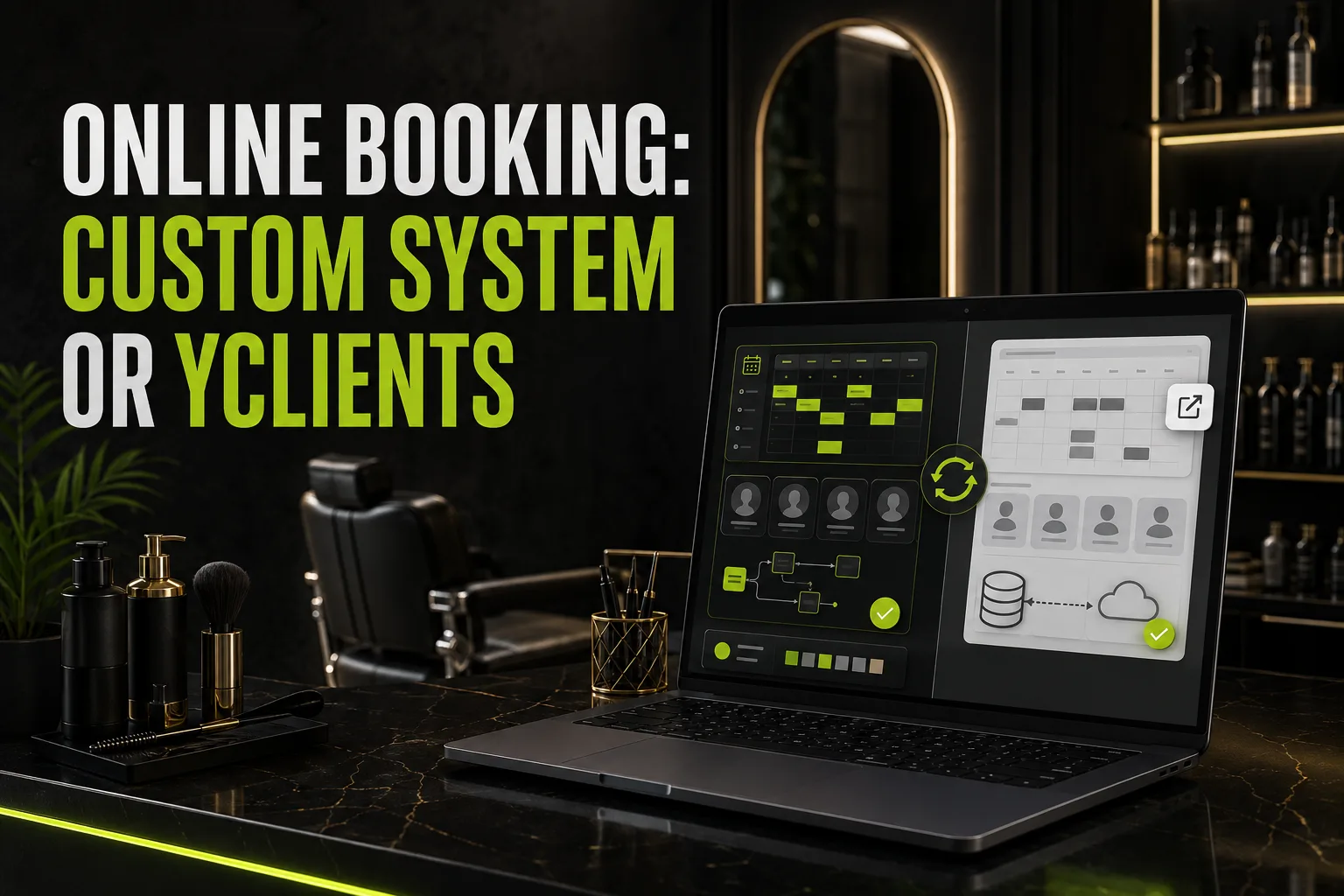
Salon online booking comes in two fundamentally different forms: a ready-made service such as Altegio, YCLIENTS or Booksy — or an in-house system inside your own website. Both work, but they differ in cost, in control and in who owns the client data. Let us look at who needs which and how to decide.
Before comparing, it is worth agreeing on the baseline. Online booking is not a "leave your number and we will call back" form. It is a system where the client sees the real free time and receives a confirmation immediately.
The essentials: choosing a service, then a specialist, then a time from a live schedule; accounting for the duration of each service, because a manicure and complex colouring are different windows; automatic confirmation and reminders; the ability to reschedule or cancel without calling; and two-way sync so time booked in the salon disappears from the site.
If any of these is missing, reception will still call back and reschedule — and online booking turns into a delayed phone call.
Altegio, YCLIENTS and Booksy are full salon management systems: schedule, client records, stock, specialist payroll, analytics. Booking there is just one module.
The strengths are obvious. Everything works immediately, with no development. There is a mobile app for reception and specialists. Visit history and material stock are tracked. Updates and support are on the service's side.
The limitations are strategic rather than technical. The booking page inside the service barely participates in search: for "manicure near me" Google shows websites and map listings, not that page. The widget looks like a foreign block and rarely matches the site's design. Client data lives inside the service — when moving to another system the database transfers partially or not at all. And the subscription grows with the number of specialists.
For a salon with 3–10 specialists already working in such a service, the healthiest decision is not to move the booking but to embed it into the website so it looks like part of the site rather than an external window.
In-house booking is a module inside your own site with the specialists' schedule in your admin panel. It is justified in three cases.
Non-standard logic. Combined services where colouring and a haircut happen in one visit with different specialists. Separate rooms or chairs as a resource. Booking for courses with limited places. Ready-made services either cannot handle such scenarios or handle them with workarounds.
The data has to be yours. The client base, visit history and marketing consents sit in your database, not someone else's. That matters if you plan your own campaigns, a loyalty programme or selling a franchise.
Many branches or specialists. A per-specialist subscription eventually exceeds the cost of building your own module, and at some point the bill becomes a noticeable expense line.
The downsides, honestly: an in-house system is development work and money up front, and it will not include stock accounting or specialist payroll unless you order them separately.
First: are you already working in a service and comfortable with it? If yes — do not change it. Embed the booking into the site and focus on getting people to the site.
Second: how much do you pay for the service per year? Multiply the monthly fee by twelve and compare it with the cost of your own module. If a year or two of fees covers the development, there is something to discuss.
Third: do you have scenarios the service cannot handle? Courses, combined visits, rooms as a resource, several branches with different price lists. If there are at least two — an in-house system will justify itself.
For most salons the right answer is a hybrid: the service stays for internal management while the site takes on traffic, trust and the first contact. We wrote about why social media cannot replace the site in a beauty salon website versus Instagram.
The typical mistake is a "Book" button that opens the service's page in a new window with different fonts, different colours and the platform's logo. The client feels thrown somewhere else, and some people drop out at that step.
The working option: the widget is embedded straight into the page, styled to your colours and fonts, with no redirects. The booking button sits in three places — in the header, on each specialist's profile with their schedule, and in the price list next to every service. Then the client books from the spot where the decision was made rather than hunting for where to tap.
Speed needs closing separately: third-party widgets are heavy, and loading them on every page at once drags mobile performance down. We connect them lazily — the block appears once the client scrolls to it.
A salon's main hidden loss is clients who book and do not turn up. The chair sits idle, the specialist loses an hour, and you will not even see it in a report.
Automatic Viber or SMS reminders a day and two hours before noticeably reduce such cases. Even better is the ability to reschedule with one tap: a person for whom the time no longer works does not vanish silently but picks another slot — and you lose neither them nor the window.
For expensive and long procedures a deposit makes sense: a small amount via LiqPay or Monobank at booking. It does not scare off reasonable clients and almost entirely removes empty four-hour windows.
A manicure every three weeks, brow correction monthly, roots every six weeks — a salon lives on returns. But booking by itself brings nobody back: it receives a client who has already decided to come.
Returns are driven by the database and reminders: after the appropriate interval the client receives a message with a "book with the same specialist" button. These are the cheapest clients you have. If booking lives in a service, such mechanics often sit in paid tiers; if the booking is yours, it is simply yours.
How to measure the return on such things is described in how to calculate a website's return.
Embedding a ready-made service into the site and styling it to your design is included in salon website development and is not billed separately. The salon site itself starts from ₴19,900 and 2–3 weeks.
An in-house booking system with specialist schedules, service durations, reminders and a client account is a separate module whose cost depends on the number of scenarios: how many branches, whether there are courses, whether rooms are a resource. We quote after the briefing and give a ballpark within 15 minutes.
What the salon site includes is collected on the page about beauty salon website development. General budget benchmarks are in how much it costs to build a website.
Salon online booking has to show the real schedule with service duration taken into account — anything else is a contact form, not booking. If you are already on Altegio or YCLIENTS and comfortable, stay there and embed the widget into your site in your own design. An in-house system makes sense when there are non-standard scenarios, several branches, or when the annual subscription already exceeds the development cost. And in both cases the money comes not from booking itself but from reminders and returning clients.
 Web development
 Analytics and Conversion
 Analytics and Conversion
 Web development
 Let’s create something amazing together
