We create digital solutions that work for businesses
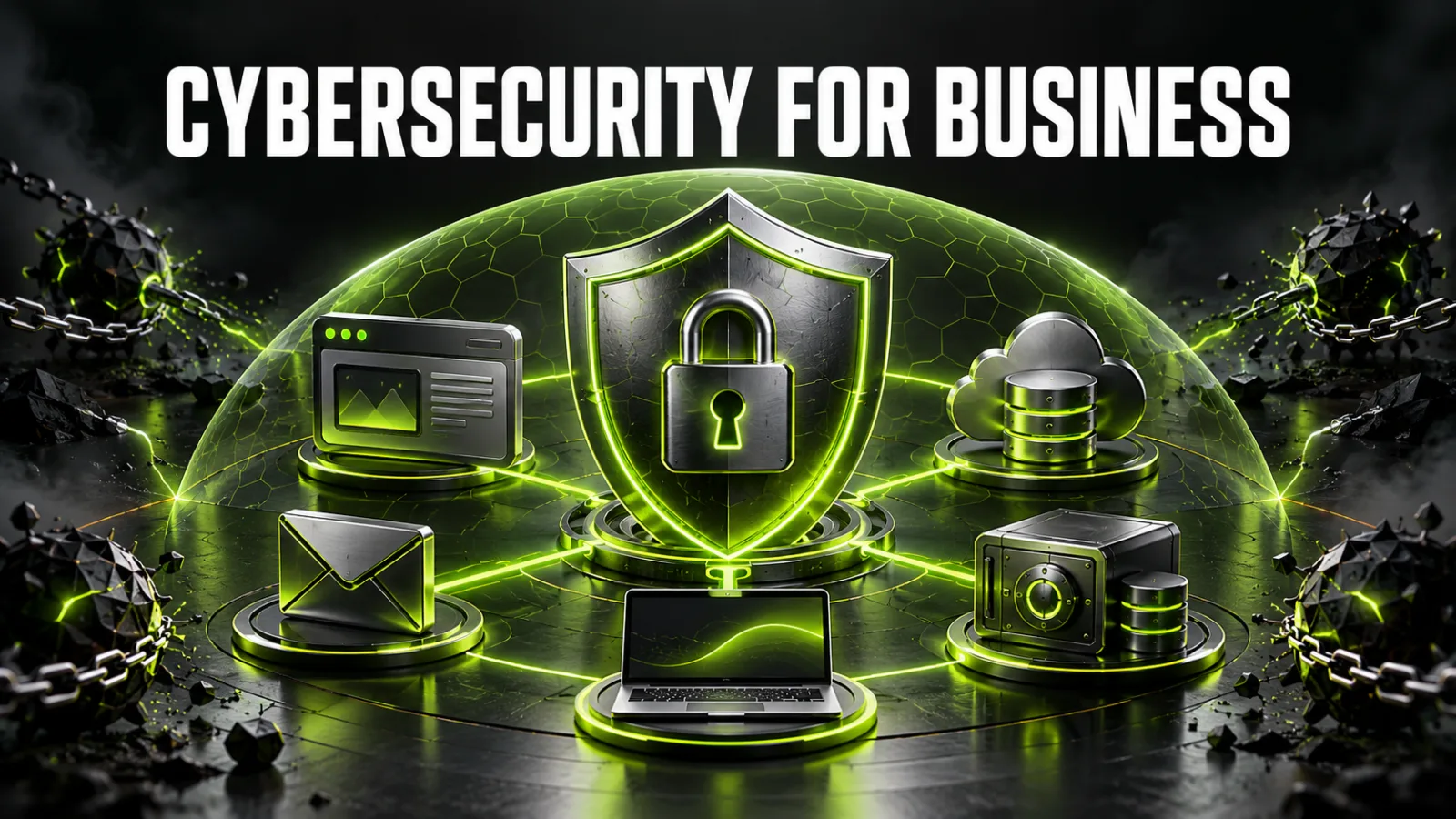
Small businesses rarely have a dedicated security department, yet they rely on the same types of digital assets as larger companies: websites, domains, business email, CRM systems, cloud storage, online banking, advertising accounts, and customer data. One stolen password can expose several of these systems at once.
Cybersecurity is not a one-time plugin installation or a promise that a breach will never happen. It is a managed process: understand what matters, reduce the likelihood of an incident, detect abnormal activity, and recover within an acceptable time. The plan below can be implemented in stages without building a large internal IT team.
Start with business assets and the consequences of losing them, not with a product purchase.
| Asset | Typical risk | Business impact |
|---|---|---|
| Domain and DNS | registrar account takeover | website and email redirection |
| Website and CMS | vulnerable plugin or weak password | malware, downtime, loss of trust |
| Business email | phishing or reused password | payment fraud and access to other services |
| CRM and cloud files | excessive permissions or stale accounts | customer and document exposure |
| Advertising accounts | account takeover | unauthorized spending |
| Work devices | malware or a lost laptop | compromised credentials and files |
| Backups | missing or untested restore | prolonged downtime after an attack |
If the website is a critical sales channel, security should be designed into website development: define roles, minimize form data, and plan updates, logging, and backups before launch.
Maintain one controlled register of domains, hosting, email, CMS, CRM, payment services, analytics, advertising, social media, cloud storage, vendors, and owners. For every asset, record the business owner, administrator, login method, recovery contact, and last review date.
Do not store passwords in this register. Its purpose is to show where access exists; secrets belong in a password manager. Confirm that the company, rather than a former employee or vendor, controls the domain and critical accounts.
Even a five-person team needs someone who coordinates updates, access, backups, and incidents. That person does not have to perform every technical task. They must know who can make decisions and how to reach the hosting provider, bank, email service, and web team.
Keep an emergency contact list outside business email. If the mailbox is compromised, information stored only inside it may be unavailable. Ongoing website support can cover updates, backups, monitoring, and critical error control.
Enable MFA for email, the domain registrar, hosting, CMS, CRM, banking, advertising, and cloud drives. Prefer phishing-resistant options such as hardware security keys or passkeys. If those are unavailable, an authenticator app is generally stronger than SMS.
Store recovery codes offline and test the recovery procedure. A second factor is weakened if an attacker can easily transfer a phone number or persuade support to change the account owner.
Every service needs a different, long password. A breach at one provider will then be less likely to unlock business email, CRM, or advertising. A business password manager supports generation, controlled sharing without sending the secret, and rapid access revocation.
Do not send passwords in chats or keep them in spreadsheets and browser notes. Separate administrative credentials so employees receive only the access required for their work.
Editors do not need full WordPress administration rights, and marketers do not always need billing control. Give every person an individual account, avoid shared admin credentials, and review permissions quarterly.
Create an offboarding checklist: disable email, revoke sessions and tokens, and remove access to CRM, cloud drives, advertising, repositories, and hosting. WordPress roles can separate content work from system administration.
Updates fix known vulnerabilities, but they should be installed through a controlled process. Separate urgent security patches from scheduled maintenance. Before a major update, create a backup, verify compatibility, and define rollback.
Cover more than the CMS, plugins, and theme. Patch the server stack, libraries, operating systems, browsers, mobile apps, and network equipment. Remove inactive components: a disabled but vulnerable plugin still remains code on the server.
A backup is not a green status badge; it is the ability to restore the business within an acceptable period. Follow the 3-2-1 principle: maintain multiple copies, use at least two types of storage or environment, and keep one copy away from the primary infrastructure. A website backup needs both files and the database.
Define RPO, the amount of data the business can lose, and RTO, the acceptable restoration time. A busy store needs more frequent database copies than a brochure site. Run a test restore at least quarterly because a broken archive discovered during an incident is not a backup strategy.
At the registrar, enable MFA, transfer lock, change notifications, and current recovery contacts. Limit who can edit DNS and review unknown records, delegated subdomains, and retired services.
When selecting website hosting, ask about account isolation, backup frequency, panel security, logging, supported software versions, monitoring, and incident procedures. A copy stored only on the same server does not protect against total infrastructure loss.
HTTPS encrypts traffic and authenticates the domain, but it does not clean an infected website or patch vulnerable code. Certificates should renew automatically, HTTP should redirect to HTTPS, and pages should not load mixed content.
Use the detailed SSL certificate and HTTPS guide for implementation and the SSL checker to inspect certificate status. After compatibility testing, add headers such as HSTS, Content-Security-Policy, X-Content-Type-Options, and a suitable referrer policy.
Keep only maintained themes and plugins from trustworthy sources. Disable file editing from the dashboard, limit login attempts, protect the administration area, remove unused features, and verify file permissions. Avoid modifying core CMS files in ways that prevent safe updates.
A security plugin may help with logging, scanning, and blocking, but it cannot replace updates, backups, and access control. Custom systems require input validation, safe session handling, API protection, and dependency review.
Email is often the recovery key for other services. Require MFA, block forwarding to unknown external addresses, monitor suspicious mailbox rules, and train staff to verify payment-detail changes through another channel.
Configure SPF, DKIM, and DMARC. Start DMARC in monitoring mode, identify legitimate senders, and progressively enforce the policy. No filter replaces a business rule: urgent payments and changed bank details must be confirmed using a known phone number, not by replying to the same message.
Enable full-disk encryption, automatic locking, updates, endpoint protection, and remote wipe where appropriate. Business data should not remain uncontrolled on personal laptops.
Separate guest Wi-Fi, replace router default passwords, and update firmware. Remote work should use managed devices and protected access. A VPN alone cannot compensate for an infected computer or a stolen password.
A web application firewall can block a portion of known malicious traffic before it reaches the server. Rate limiting reduces password spraying, form abuse, and API overload. Public forms need bot controls, server-side validation, and file-size and file-type restrictions.
For e-commerce development, also protect customer accounts, minimize payment data, authenticate webhooks, log order changes, and review payment and delivery integrations. Avoid storing card data on the web server unless it is essential and governed by an appropriately controlled process.
Monitor administrator logins, role changes, plugin installations, DNS edits, server errors, bulk exports, and abnormal payments. Alerts must reach an accountable person. Logs should be protected separately and must not contain passwords, tokens, or complete payment details.
Uptime monitoring is not security monitoring. Add file-integrity checks, certificate-expiry alerts, domain reputation checks, and backup monitoring. BB STUDIO tools can help with initial technical checks, but an automated scan does not replace configuration and business-risk analysis.
If an infection has placed spam pages in the search index, recovery should include technical analysis and website SEO: remove malicious URLs, restore correct server responses, update the sitemap, and monitor recrawling.
The plan can be short, but it must answer five questions: who leads, how the spread is contained, what evidence is preserved, who must be informed, and how service is restored. Include scenarios for email takeover, website infection, payment fraud, data exposure, and ransomware.
Do not immediately delete everything. Hasty cleanup can destroy evidence and leave hidden access in place. Isolate the affected system, record the time and symptoms, rotate compromised secrets from a clean device, involve relevant providers, and restore from a verified backup. Run a blameless review afterward to address the root cause.
Rate each risk by likelihood and impact. High-value early actions are inexpensive but cover many scenarios: MFA, a password manager, removal of stale access, automatic updates, off-site backups, and restoration testing.
| Priority | Do now | Schedule next |
|---|---|---|
| Critical | MFA for email, domain, and finance; backups; remove unnecessary access | restore test and incident plan |
| High | patch CMS and devices; roles; email protection | WAF, centralized logs, staff training |
| Medium | security headers; bot control; supplier register | vulnerability scanning and tabletop exercise |
Week 1: inventory systems, assign owners, enable MFA for email, domain, hosting, and financial services, and remove access belonging to former staff and vendors.
Week 2: patch the CMS, plugins, devices, and router. Review HTTPS, roles, forms, SPF/DKIM/DMARC, and email-forwarding rules.
Week 3: configure off-site backups, perform a test restore, enable logs and critical alerts, and document RPO and RTO.
Week 4: write a short incident plan, run a 30-minute tabletop exercise, create the next improvement backlog, and set the next review date.
Effective small business cybersecurity starts with control, not an expensive product: assets are known, access is limited, MFA is enabled, systems are patched, backups can restore operations, and the team knows what to do first. Review the controls after adding a new service, changing a vendor, or experiencing an incident, and at least once every quarter.
To review the website, hosting, access, and backup setup and turn the findings into a prioritized security plan, contact BB STUDIO.
 CRM and Business Automation
 CRM and Business Automation
 For business
 Web development
 Let’s create something amazing together
