We create digital solutions that work for businesses
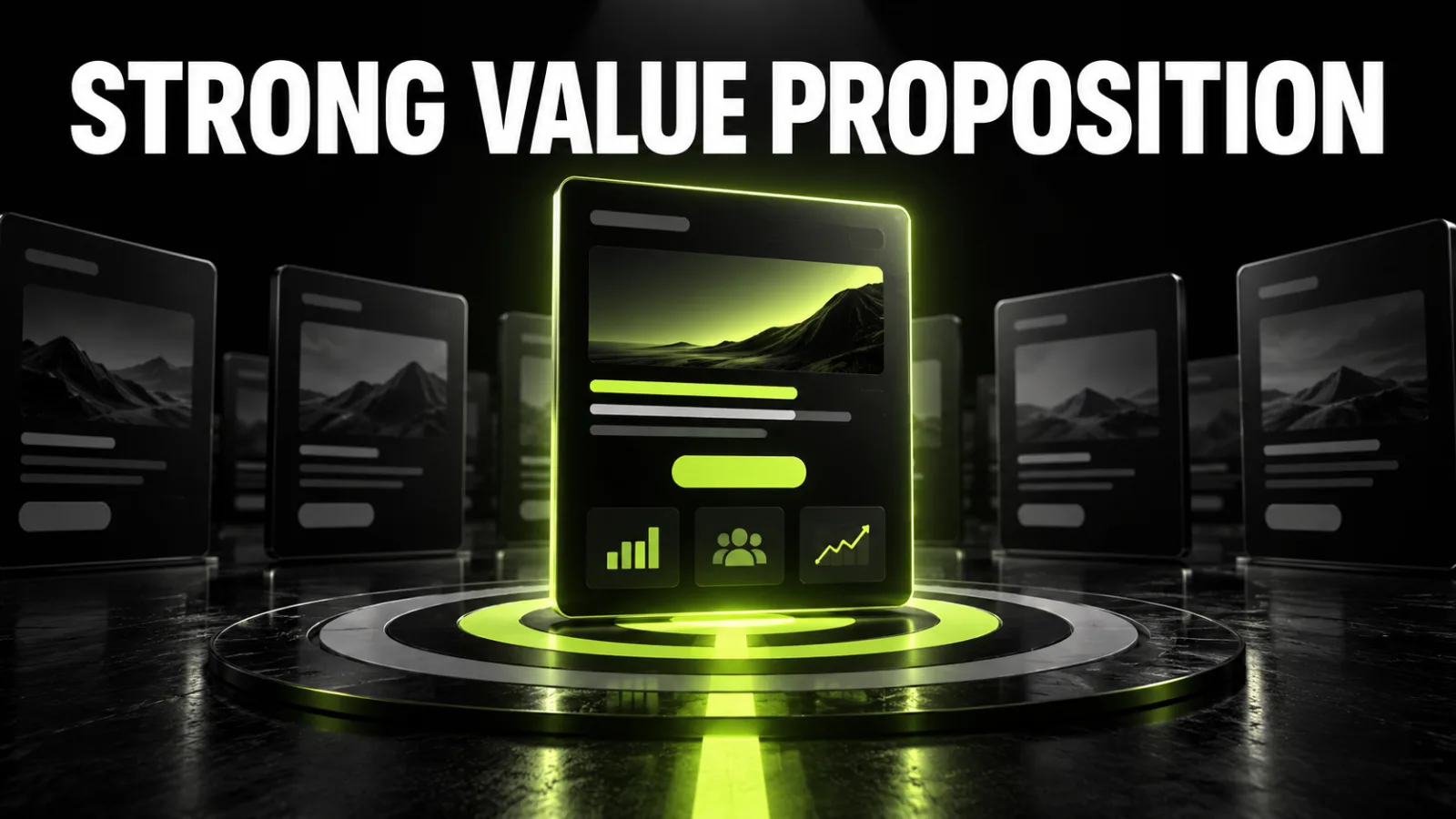
Visitors do not open a website to admire a slogan. They want to understand whether the company solves their problem, why it is credible, how it differs from alternatives and what they should do next. “Quality you can trust” makes people perform that interpretation themselves.
A value proposition does not need to describe a feature that exists nowhere else in the world. It needs to connect a specific customer, an important job, a valuable outcome, relevant conditions and believable evidence. If the wider acquisition system is still unclear, start with the guide to getting customers for a small business.
A strong proposition answers five questions:
A practical formula is:
We help [specific customer] achieve [clear outcome] through [solution or mechanism], with [important condition or proof].
For example:
We build conversion-ready websites for small and medium-sized businesses, combining structure, responsive design and analytics in one delivery team.
This is raw material rather than a finished headline. It can be shortened for each page and campaign. Website design and redesign turns that positioning into information architecture, journeys and a coherent interface.
| Element | Purpose | Example |
|---|---|---|
| Value proposition | complete value logic for a segment | launch online sales without coordinating five suppliers |
| Differentiated promise | reason to consider the company | website, content, analytics and ad launch in one team |
| Offer | a concrete package and conditions | corporate website from a stated price with defined scope |
| Headline | concise page-specific version | A business website ready for leads and campaigns |
| Slogan | memorable brand expression | Digital solutions that work |
| Promotion | temporary incentive | Google Ads setup included |
A slogan can be broad and emotional. A landing-page headline must be more specific. A promotion may strengthen an offer, but a discount cannot replace underlying value.
Almost every competitor uses those words. They do not explain the deliverable or the standard by which the claim can be judged.
Replace abstraction with criteria:
| Vague | More concrete |
|---|---|
| high quality | three-month warranty and a documented pre-launch test |
| fast | landing page from seven working days after content approval |
| tailored approach | page structure designed around services, audience and the enquiry journey |
| affordable | defined scope and a starting price without hidden required modules |
| professional team | named roles for design, development, SEO and project management |
Specificity must remain truthful. Do not invent numbers because they sound persuasive.
A proposition for everyone becomes generic. A new business owner may need a controlled launch, a marketing manager needs conversion and measurement, while a larger company prioritises integrations, security and governance.
Describe a segment through:
“Owners of local service firms running search ads to an outdated website without reliable lead tracking” is more useful than a demographic range.
Customers buy progress, not isolated features. A company may sell CRM software, while its customer wants to stop losing enquiries. A furniture maker sells cabinets, while the buyer wants to fit a difficult room, budget and moving deadline.
Collect evidence from:
Ask about the last real decision: what triggered it, which alternatives were considered, what created doubt and what success looked like. Hypothetical preferences are less valuable than remembered behaviour.
| Jobs | Pains and risks | Desired gains |
|---|---|---|
| launch before advertising starts | delays, hidden costs, missing content | clear plan, controlled stages, campaign readiness |
| generate enquiries | traffic without working forms or attribution | measurable leads with reliable source data |
| update pages internally | permanent developer dependency | usable CMS and training |
| grow organic search | rebuilding the structure later | technical and content foundations from launch |
Compare this map with genuine business capabilities. The strongest proposition sits at the intersection of an important need, a deliverable competence and a meaningful difference from typical alternatives.
Alternatives include direct competitors, freelancers, templates, website builders, internal hires, social media instead of a website and doing nothing.
Record for each option:
Being different is not enough. The difference must matter. “Built with technology X” is weak when buyers cannot connect it with speed, reliability, control or revenue.
Differentiation may come from:
Select one primary difference and two or three supporting pillars. A list of nine equal benefits gives customers no clear reason to remember the offer.
Use several structures instead of polishing the first sentence.
Websites for local service companies that connect service pages, Maps, analytics and a simple enquiry flow.
Turn an outdated website with weak enquiries into a measurable customer-acquisition channel.
Launch a campaign landing page from seven working days after structure and content approval.
One delivery team instead of separately coordinating a designer, developer and analytics specialist.
Websites for service businesses designed around enquiry journeys, relevant cases and analytics.
Remove words that carry no testable meaning: innovative, unique, best or comprehensive without a defined scope.
A proposition without proof remains a claim. Relevant evidence includes:
Anonymous praise, unexplained logos and unverifiable numbers are weak evidence. One detailed case may be more persuasive than ten generic badges.
The full idea rarely fits in one line. Build the first screen from five elements:
Example:
H1: Corporate websites for service businesses
Support: Strategy, design, forms, analytics and SEO foundations delivered by one team.
Proof: From UAH 19,900 · 2–4 weeks · three-month warranty.
CTA: Get an estimate.
A focused landing page suits one campaign or segment. Multiple services, cases and organic-search topics often require complete website development.
These are structures to adapt, not promises to copy.
Weak: “Modern dentistry for the whole family.”
Clearer: “Dental care for adults and children in one clinic, with digital diagnostics, a treatment-cost plan before work begins and convenient booking.”
Weak: “Reliable legal protection.”
Clearer: “Contract and commercial-dispute support for businesses, beginning with document review and a written action plan.”
Weak: “Quality construction delivered on time.”
Clearer: “Private-home construction with staged estimates, technical supervision and photo reports for every milestone.”
Weak: “Furniture of your dreams.”
Clearer: “Custom kitchens designed for your exact room, with a 3D concept, itemised materials and installation to an agreed schedule.”
Weak: “European quality from the manufacturer.”
Clearer: “Batch production of metal components from drawings, including inspection, measurement records and delivery across Ukraine and the EU.”
Weak: “A huge choice at the best prices.”
Clearer: “Ukrainian-made bedding with size guidance, dispatch within 24 hours and understandable exchange conditions.”
Every example needs operational validation. Never promise a deadline, location or guarantee the team cannot consistently support.
Do not force every audience into one headline. Use a hierarchy:
This structure keeps the site clear while giving advertising and SEO a relevant destination.
Price should not be the only difference unless the business has a durable low-cost model. Discounts are easy to copy and may attract customers who select purely on the lowest number.
Explain instead:
The BB STUDIO prices page provides starting points and scope instead of hiding every number until a call.
If an advert promises “campaign landing page from seven days”, the destination should not begin with an abstract paragraph about digital transformation. Search intent, ad, H1, proof, form and the sales response should continue the same offer.
Professional Google Ads management therefore includes more than keyword selection: the page and measurable next action also need review.
Do not replace a recognisable service name with a creative slogan. A heading can contain both demand and value:
Weak for search: “Building the future together.”
Clearer: “Ecommerce website development with payments, delivery and CRM.”
Use the primary query and a relevant modifier in the title, then explain terms, process, proof, pricing and common questions. A value proposition is not keyword repetition; it makes the page answer intent more completely.
Run a five-second test. Show the hero section to people unfamiliar with the company, remove it and ask:
Other useful methods are customer interviews, ad-headline tests, hero prototypes, search-query analysis, session recordings, post-sale surveys, A/B testing and CRM lead-quality comparisons.
When traffic exists but enquiries remain weak, review the 12 reasons a website gets traffic but no leads. Messaging may be only one issue alongside speed, forms, mobile usability or irrelevant acquisition.
Choose one audience and one buying situation.
Describe the functional, emotional and social job: what customers want to achieve, feel and signal.
List five pre-purchase risks and five real reasons for lost sales.
Choose one primary difference and three forms of evidence the business can reliably deliver.
Draft ten versions using different formulas. Reduce each to one headline and two lines of support.
Score clarity, relevance, specificity, evidence and operational truth. Select two variants for testing.
A strong value proposition does not begin with impressive adjectives. It emerges when a business selects a segment, understands its job, identifies a meaningful difference and proves the promise. On a website, that logic should remain consistent from the H1 to the conditions, cases, form and sales conversation.
If your positioning needs to become a clear website structure and conversion journey, discuss the project with BB STUDIO. The wider design context is covered in UI/UX design that converts.
 For business
 For business
 For business
 For business
 Let’s create something amazing together
