VAT for FOPs in Ukraine from 2028: the €85,000 threshold, who is affected and how much to pay
For business
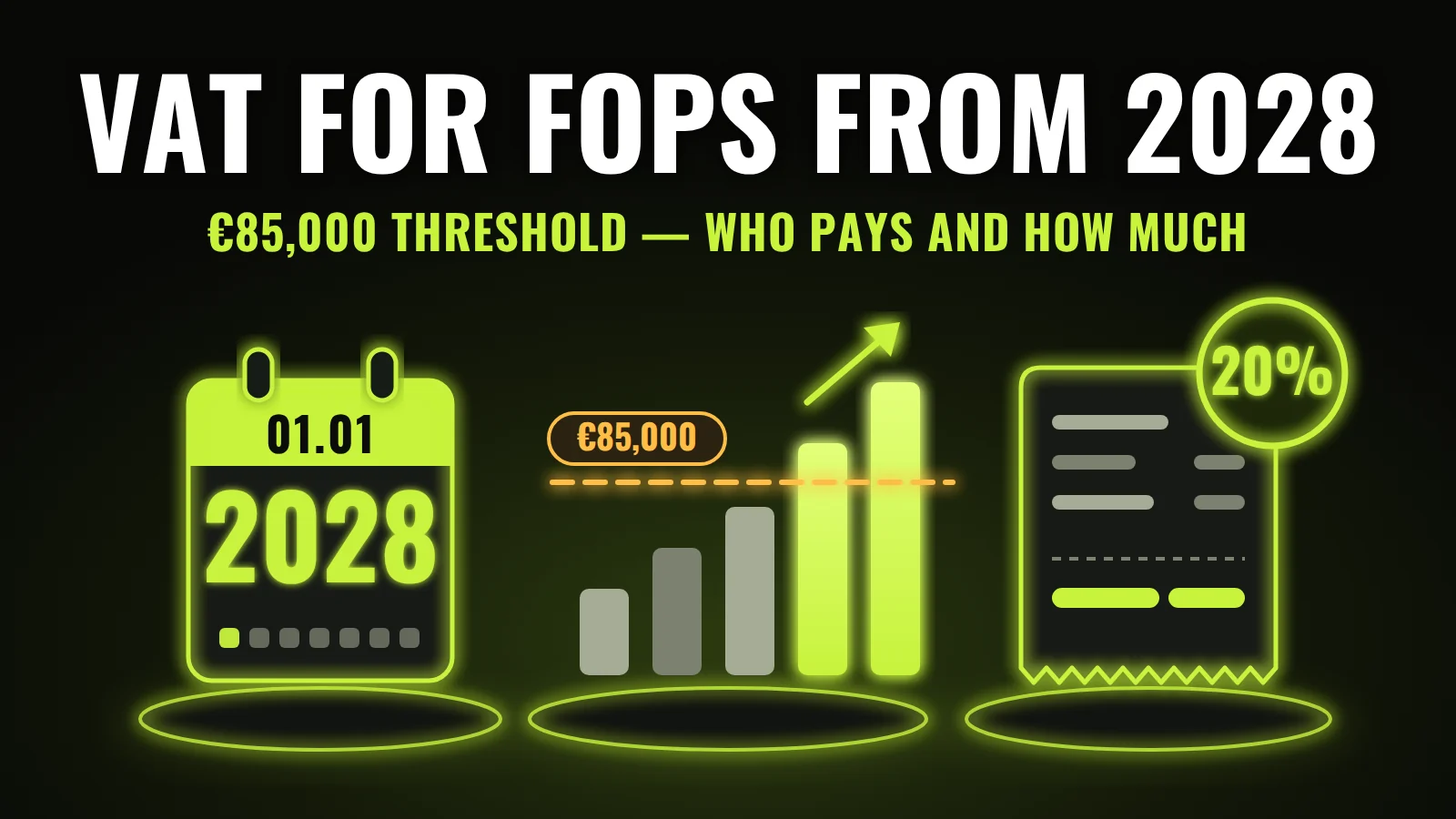
VAT for Ukrainian sole proprietors (FOPs) has not been cancelled — it has been postponed. As of 19 October 2026 the plan is this: from 1 January 2028, entrepreneurs on the simplified tax system with a turnover above €85,000 a year (about ₴4.37 million) are to become VAT payers. The law has to be passed by the end of April 2027, and there is no text yet.
Below: what has been decided and what has not, who will be affected, how much you would pay, with examples for an online store and for services, and what is worth doing right now. We are a group 3 FOP ourselves, so we calculate the way we would for our own business. This is an overview as of 19 October 2026, not tax advice.
Want numbers for your own FOP right away? The VAT calculator for FOPs shows whether you will have to register and how much you would pay with VAT.
Key takeaways as of October 2026
VAT for FOPs is most likely coming. It is the government’s commitment to the IMF, and it has been postponed, not cancelled. But the Rada still has to pass the law.
When. Under the plan, from 1 January 2028. The law has to be passed by the end of April 2027.
Threshold. €85,000 of turnover a year — the highest the EU allows. At the National Bank of Ukraine (NBU) rate in September 2026 that is about ₴4.37 million.
Who is affected. Group 2 and 3 FOPs with turnover above the threshold. Group 1 is not: its limit is below the threshold.
How much. For group 3 under the current rules: a 3% single tax instead of 5%, plus 20% VAT minus the VAT you pay on purchases.
What to do. Track your turnover over 12 months, sort your clients into VAT payers and non-payers, and prepare prices, contracts, your website and your accounting. Splitting the business into several FOPs is risky.
What has been decided and what has not
Question
Status as of October 2026
Will FOPs pay VAT
Most likely: it is a commitment to the IMF
From which year
From 1 January 2028 — government and IMF plan
Turnover threshold
€85,000 a year ≈ ₴4.37 million — preliminarily agreed
The law
Due by the end of April 2027; no text yet
Single tax with VAT
3% for group 3 — current rule, the law may change it
VAT returns
Monthly or quarterly — bill 16037-d, first reading only
How we got here: a timeline
December 2025. The Ministry of Finance publishes a draft: mandatory VAT for FOPs with turnover above ₴1 million, from 1 January 2027 at the earliest. Under that draft, groups 1 and 2 kept their single tax and paid VAT on top.
10 March 2026. The Verkhovna Rada votes down bill No. 14025, which bundled VAT for FOPs with taxes on parcels and digital platforms: 168 votes out of the 226 needed.
March–April 2026. The Ministry of Finance proposes raising the threshold to ₴4 million, and the government and the IMF discuss a delay of at least a year.
July 2026. A new memorandum with the IMF: the law by the end of April 2027, the start on 1 January 2028. The threshold can be raised, but not above the maximum the EU directive allows.
22 September 2026. Deputy Minister of Finance Svitlana Vorobei: Ukraine and its donors have agreed on the highest possible threshold — €85,000 a year.
13 October 2026. The Rada passes bill 16037-d on simpler VAT administration at first reading: FOPs who pay VAT may choose a monthly or quarterly reporting period, sales to non-payers get one consolidated tax invoice, and returns come pre-filled.
Who is affected: groups 1, 2 and 3
The threshold is compared with turnover — all receipts from sales — not with profit. The single tax group limits are tied to the minimum wage, so they change every year.
Group
Income limit 2026
Limit 2027 (draft)
Affected by VAT
Group 1
₴1,444,049
₴1,594,182
no: limit below threshold
Group 2
₴7,211,598
₴7,961,364
yes, if above threshold
Group 3
₴10,091,049
₴11,140,182
yes, if above threshold
Exactly how turnover will be counted is for the law to decide. In the Ministry of Finance’s March draft, turnover was to be counted over the previous 12 calendar months from quarterly returns for group 3 and from the previous year’s income for group 2, and the tax service itself was to register businesses as VAT payers from 1 January. These details may still change.
What will happen to group 2 itself is also an open question. The government has committed to the IMF to review groups 2 and 3 in 2027: moving some activities from group 2 to group 3 and introducing rates of up to 10% for some services in group 3. There are no specific lists yet.
One more fact: according to Svitlana Vorobei, more than a thousand FOPs on both the general and the simplified system are already VAT payers. For some businesses it even pays off — we will show which ones below.
How much you would pay: three examples
The VAT rate is 20%. For a business client that pays VAT, you simply add 20% to the price, and the client gets it back as a tax credit: nothing becomes more expensive for them. A private customer cannot reclaim VAT, so there are two options: raise the price or pay the VAT out of your margin — that is 1/6 of every receipt. On the other hand, the VAT you pay to suppliers on purchases is deducted: that is your tax credit (input VAT).
We calculated three typical cases for group 3 at the current rates. Without VAT: a 5% single tax and a 1% military levy. With VAT: 3% and 1% of income excluding VAT. Prices for private customers stay the same, prices for businesses go up by 20%. The single social contribution (ESV) is the same in both cases, so it is left out.
Online store
Consumer services
B2B services
Turnover now
₴6,000,000
₴5,000,000
₴6,000,000
Clients
private customers
private customers
VAT payers
Purchases with VAT a year
₴3,600,000
none
₴600,000
Receipts incl. VAT
₴6,000,000
₴5,000,000
₴7,200,000
Taxes now: 5% and 1%
₴360,000
₴300,000
₴360,000
With VAT: 3% and 1%
₴200,000
₴166,667
₴240,000
VAT payable
₴400,000
₴833,333
₴1,100,000
Total taxes with VAT
₴600,000
₴1,000,000
₴1,340,000
Change per year
−₴240,000
−₴700,000
+₴220,000
Raise prices for private customers
by ≈5%
by ≈17.5%
not needed
Why the store loses less: it buys goods from VAT payers, and ₴600,000 of tax credit covers most of the VAT on its sales. Consumer services have almost no purchases with VAT, so there is no credit to claim, and for them VAT means minus 1/6 of revenue. For B2B services, registration even pays off: clients pay 20% on top and reclaim it, while you pay 3% instead of 5% and reclaim the VAT on your purchases. The examples do not include accounting costs or the risk of tax invoices being blocked.
Group 2 cannot be VAT-registered today, so for group 2 this assumes the law lets you stay in the group with VAT, as the Ministry of Finance’s December draft proposed. Then the fixed single tax does not change, and the difference comes from VAT alone. Example: turnover of ₴5 million, private customers, purchases with VAT of ₴1.5 million a year. VAT payable is ₴583,333 a year, and to earn the same you would need to raise prices by about 14%.
Calculate your own caseEnter your turnover, the share of sales to VAT payers and your purchases with VAT — the calculator shows whether you will have to register and how much you would pay.Open the calculatorFOP taxes today →
What this means for prices and your website
If you sell to private customers, VAT will end up either in your prices or in your margin. Start with the numbers: what your turnover will be in 2027, how much you buy with VAT, and how much of the VAT you are ready to absorb and how much to pass on in prices.
Once you are a VAT payer, your website and accounting will need:
Prices with VAT. Prices including VAT and the tax rate on the website and on PRRO (software cash register) receipts. Business clients find it convenient to see prices both with and without VAT.
Invoices and acceptance acts with VAT. As separate lines: the amount excluding VAT, VAT at 20% and the total. For simple cases our invoice and acceptance act generator will do, and the Amount in words tool writes the total out in words, VAT included.
Tax invoices. They are registered in the Unified Register of Tax Invoices for every sale, including sales to non-payers. For sales to non-payers, bill 16037-d proposes one consolidated tax invoice a month.
Purchase records. The tax credit comes from registered tax invoices from suppliers who pay VAT (for imports, from customs declarations), so find out in advance which of your suppliers are VAT payers.
Orders passed to accounting. With many sales, doing this by hand is not realistic. Orders from the website are better passed to BAS, 1C or another accounting system automatically — we explained how in our article on ERP integration.
We will get your website ready for VATPrices with and without VAT, invoices, online payment, orders passed to BAS or 1C. No prepayment, under a contract.Discuss your websiteTurnkey online store →
Does it pay to register for VAT voluntarily now?
For some group 3 FOPs — yes, and there is no need to wait until 2028. It pays off when most of your clients are VAT payers and your purchases with VAT are substantial: clients will not feel a price increase, while you pay 3% instead of 5% and reclaim the VAT on purchases. It does not pay off when you sell mostly to private customers and buy almost nothing with VAT.
You can switch to the 3% rate from the start of a quarter by applying in advance, and you register as a VAT payer with a separate application. Check the deadlines and the procedure with an accountant: a mistake here costs more than a consultation.
Will splitting the business into several FOPs help?
It is the first thing that comes to mind, and it is exactly what the government and the IMF agreed to guard against. The government is to draw up rules against artificial business splitting and sham switching between tax regimes by the end of December 2026. The memorandum also provides for pilot projects to find businesses that artificially hold down their turnover to avoid registering for VAT.
A split without a real business purpose — separate lines of business, teams, clients — can lead to additional tax assessments. If your business really consists of different lines, discuss it with an accountant before the law is passed.
What to do now: a plan for 2026–2027
Track your turnover over the last 12 months. Every quarter, not once a year: that way you will see in advance that you are approaching ₴4.37 million. Taxes under the current rules are in the FOP tax calculator.
Sort your clients. How much revenue comes from VAT payers and how much from private customers and non-payers. This decides whether VAT is a minus or a plus for you.
Check your purchases. Which suppliers are VAT payers and how much VAT you already pay in their prices. That is your future tax credit.
Review contracts and prices. In new contracts and your public offer, state prices “excluding VAT” and say that VAT will be added once you register as a VAT payer, so you do not have to argue with clients later.
Prepare your website and accounting. Prices with VAT, invoices, receipts and passing orders to an accounting system are easier to set up in advance than in December 2027.
Do not rush into irreversible steps. Do not change your group or restructure the business until the text of the law is published.
Keep an eye on the bill. The law has to be passed by the end of April 2027. We will update this article and the calculator as soon as the text appears.
Other changes for FOPs that are close
Tax on income from digital platforms. The Rada passed the law (bill No. 15111-d) on 9 June 2026, but as of mid-October the President had not signed it; on 15 October the Rada passed amendments meant to unblock this. The main provisions are due to apply from 1 January 2027. Marketplaces and online services will report sellers’ income to the tax service. For individuals the rate is 10% with no military levy, and selling personal belongings for up to €2,000 a year is not taxed. If you are a FOP selling through a marketplace, the tax service will see that turnover too.
New amounts for 2027. Under the draft budget, the minimum wage from 1 January 2027 would be ₴9,546. So ESV would start at ₴2,100.12 a month, the group 2 single tax would be up to ₴1,909.20 a month, the military levy for groups 1 and 2 would be ₴954.60 a month, and the group 3 limit is ₴11,140,182. The final amounts will be known once the budget is passed.
Review of groups 2 and 3. The government has committed to the IMF that in 2027 it will move some activities from group 2 to group 3 and introduce rates of up to 10% for some services in group 3. There are no lists or rates yet.
We are a group 3 FOP ourselves and we are keeping track of the VAT plans. Want to get your website ready in advance? Write to us — during business hours we reply within 15 minutes and will suggest what to change on your website and what it might cost.

Under the plan of the government and the IMF, from 1 January 2028. The law removing the VAT exemption for the simplified system has to be passed by the end of April 2027. As of October 2026 there is no draft law yet.
€85,000 a year has been preliminarily agreed — the maximum the EU directive allows. At the NBU rate in September 2026 that is about ₴4.37 million. Whether the threshold will be counted in euros or in hryvnias at the exchange rate is for the law to decide.
No. The group 1 income limit is ₴1,444,049 in 2026 and ₴1,594,182 in 2027 under the draft budget. That is below the threshold, so group 1 will not have to pay VAT.
Under the current rules: a 3% single tax and a 1% military levy on income excluding VAT, plus VAT — 20% on sales minus the VAT on purchases. For example, a store with a turnover of ₴6 million and purchases with VAT of ₴3.6 million would pay about ₴600,000 a year instead of ₴360,000.
Yes, in group 3 you can do it today: register as a VAT payer and switch to the 3% rate from the start of a quarter. It pays off if most of your clients are VAT payers and your purchases with VAT are large.
It is risky. The government has committed to drawing up rules against artificial business splitting by the end of 2026, and the IMF memorandum provides for pilot projects to find those who artificially hold down their turnover. A split without a real business purpose can lead to additional tax assessments.
For private customers, VAT will end up either in the price or in the store’s margin. How much depends on purchases: in our example the store only needs to raise prices by about 5%, while services without purchases with VAT would need 17.5%.