We create digital solutions that work for businesses

Drivers rarely search because they want to browse a website. A warning light appeared, the car started making noise, scheduled maintenance is due, or a breakdown needs urgent attention. They need three answers quickly: does the shop handle the job, can it be trusted, and when can the vehicle be accepted?
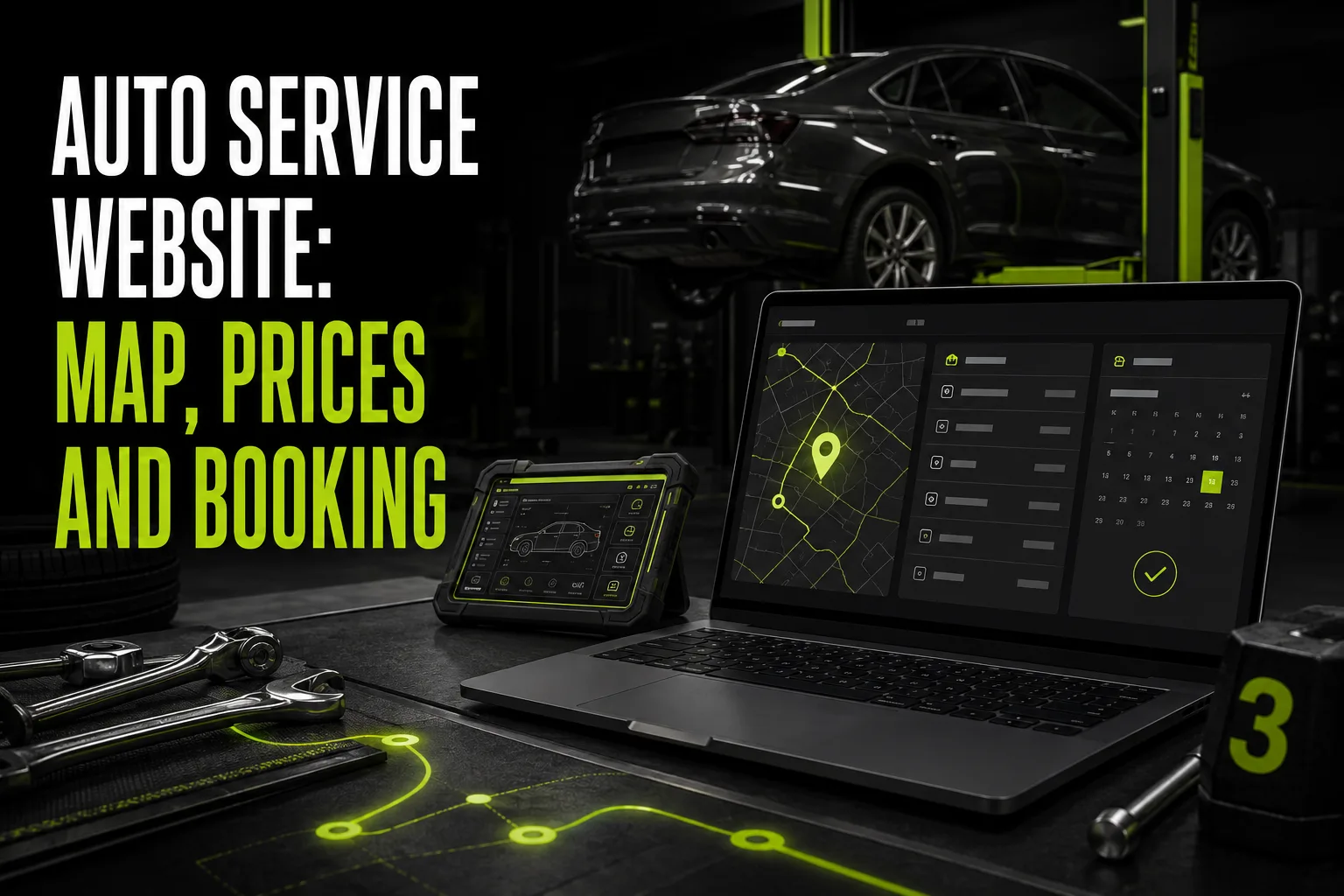
That is why professional business website development in this market is more than a digital brochure. The website should turn local demand into calls and confirmed bookings, reduce repetitive work for service advisors, and bring customers back for future maintenance.
A map listing is excellent for an address, hours, directions, reviews, and quick calls. Social media can show repairs, people, and short tips. Directories may generate initial enquiries. Yet every third-party platform limits your structure, controls visibility, and places competing shops beside your business.
An owned website allows a repair shop to:
build a substantial page for each priority service;
explain diagnostics, scope, timing, warranty, and pricing logic;
show real technicians, facilities, equipment, and completed work;
accept enquiries around the clock and collect useful details;
send paid traffic to a matching landing page instead of a generic profile;
connect the original source with a booking, arrival, invoice, and repeat visit;
build organic visibility as a long-term business asset.
Maps, video, directories, and social channels should still contribute attention. The website becomes the controlled destination where customers evaluate the evidence and take the next step.
A general shop supports many makes and a broad range of work. Its main information challenge is avoiding a chaotic menu. Group services into diagnostics, maintenance, engine, suspension, brakes, electrical systems, air conditioning, and tyres, then provide an obvious route to each important job.
This business sells knowledge of common faults, brand-specific diagnostic tools, experienced technicians, and predictable parts sourcing. Make pages need genuine differences: supported models, recurring repairs, relevant technology, cases, and specialist staff. Copying one generic paragraph across dozens of manufacturer names creates little value.
Transmission rebuilding, automotive electrical work, exhausts, body repairs, or climate systems require deeper explanations of testing, equipment, repair limits, and warranty. The website may be smaller, but each page should demonstrate stronger subject expertise.
A network needs a page for every real location, a shared service catalogue, nearest-shop selection, central reporting, and accurate routing of bookings. Prices and capacity may differ by branch, so they should come from a controlled source rather than conflicting page copy.
Match a problem to a service. Some drivers know the repair name; others can describe only a symptom.
Prove competence. Equipment, people, process, examples, and warranty terms should be verifiable.
Set a pricing expectation. Explain diagnostic charges, labour rates or common jobs and the reasons a final quote may change.
Make location choice easy. Address, entrance, opening hours, directions, and availability should be prominent.
Capture a useful booking. Ask for the service or symptom, vehicle, preferred time, and contact details without excessive friction.
Acquire local demand. The architecture supports relevant service, make, and location searches.
Measure the business result. Connect a source to a confirmed booking, arrival, repair order, revenue, and margin.
Encourage retention. Maintenance and seasonal reminders create repeat visits without relying on constant reacquisition.
More general planning resources are available in the web development blog.
A useful funnel is:
search or map → service/location page → price and proof → call or form → confirmed booking → vehicle arrival → diagnosis → approval → payment → reminder → repeat visit
One person searches for “brake pad replacement,” while another types “knocking sound over bumps.” The site must help both. Symptom guides can suggest possible causes and an appropriate next step, but they should not claim to provide a remote diagnosis. The same symptom can have multiple causes, including safety-critical ones.
| Page | Essential content | Primary action |
|---|---|---|
| Home | positioning, services, location, proof, reviews | choose a service or book |
| Service directory | logical repair groups and short explanations | open the relevant service |
| Service page | symptoms, diagnosis, process, price, timing, warranty | book diagnosis or repair |
| Vehicle makes | supported makes, tools, experience | choose the relevant make |
| Pricing | diagnostics, common jobs, labour policy, notes | request an estimate |
| Online booking | service, vehicle, time, contact, confirmation | submit or reserve |
| Case studies | fault, testing, solution, outcome | review a similar repair |
| About | technicians, equipment, standards, warranty | verify the shop |
| Location | map, entrance photos, hours, transport | get directions |
| Blog | symptoms, maintenance, seasonal advice, parts | continue to a service |
| Contact | phone, messaging, details, form | contact the shop |
| Legal | privacy, cookies, booking policy | understand the terms |
The broader logic is covered in this guide to business website structure.
“Quality car repair” does not communicate a specialty. A stronger line names the work, vehicles, area, and action: “BMW and MINI diagnostics and repair in Luton — book a convenient time.” Place a phone number, booking button, hours, and one verifiable proof point nearby.
Popular jobs should not hide inside a long menu. Use clear cards for diagnostics, oil service, suspension, brakes, engine, electrics, air conditioning, and tyres. Add a separate “I am not sure what is wrong” route with a symptom field.
Unsupported “best shop” claims weaken trust. Real facility photos, named equipment, technician profiles, current certificates, vehicle intake procedures, photographic reports, and written warranty conditions are stronger.
Show the exact address, map, landmarks, and entrance photos. Explain waiting facilities, public transport, after-hours key drop, or vehicle storage if offered. A group should ask users to choose a branch before displaying hours and availability.
Each page should answer one coherent intent, such as suspension diagnostics, timing belt replacement, alternator repair, or air-conditioning recharge.
A practical sequence is:
Service, intended result, and available location.
Symptoms that justify an inspection.
What the initial check includes.
Diagnostic and repair process.
Typical duration and causes of delay.
Labour price and excluded items.
Parts options and approval rules.
Relevant tools and technician experience.
Clear warranty scope and exceptions.
Related cases and attributable reviews.
Frequently asked questions.
Booking action and phone number.
Avoid a separate URL for every keyword variation. If “suspension repair” and “car suspension service” represent the same intent and offer, one authoritative page is usually better than two near-duplicates.
The final repair price often becomes clear only after inspection and strip-down. That does not justify hiding every number. A credible website can show:
a fixed diagnostic charge;
a “from” price for a common job with the base scope defined;
the labour rate when the business actually uses it;
labour, fluids, consumables, and parts separately;
price variables such as make, model, engine, access, corrosion, and secondary damage;
the price-list date and how additional work is authorised.
An initial estimate must not look like a final invoice. After diagnosis, the customer should receive the proposed jobs, parts, total, and a chance to approve changes before they are carried out.
For a small workshop, a short request is often enough: name, phone, make/model, service or symptom, and preferred day. The confirmation screen should say that a service advisor will confirm the time. A submitted form is not automatically a reserved slot.
A real booking calendar works only when the system understands capacity: branch, technician, bay or lift, specialist equipment, job duration, and buffers. An oil change cannot be scheduled with the same resource rules as intermittent electrical diagnostics or an engine rebuild.
Ask only for what is needed at each step. A VIN or registration number can support parts identification, but collect it for a stated purpose and protect it appropriately. Control uploaded image and video formats, file size, retention, and staff access.
After booking, send the confirmed address, time, rescheduling terms, and preparation instructions. A reminder can reduce missed appointments, but marketing communication needs its own appropriate consent and opt-out.
A “Volkswagen service” page is valuable when the shop has actual specialist experience: compatible diagnostic technology, technical data access, model knowledge, relevant technicians, and cases. If none of those differ, dozens of templated make pages do not become useful simply because the manufacturer name changes.
Model pages are justified by meaningful demand and unique material. Do not mass-produce every combination of service, make, neighbourhood, and model. Fewer pages with real answers, navigation, and evidence form a stronger site.
A local programme combines the website with an accurate business profile. Google describes local ranking primarily in terms of relevance, distance, and prominence. No legitimate supplier can guarantee the first map position, but the underlying information and experience can be improved systematically.
The baseline includes:
Keep the real business name, categories, address or service area, phone, and hours consistent.
Verify the profile and use genuine exterior, entrance, workshop, and team photos.
Build substantial pages for priority services and connect them with the location.
Give every real branch a useful page with unique local details.
Request reviews after completed work without buying ratings or prescribing praise.
Respond constructively without exposing a customer’s or vehicle’s private information.
Add accurate LocalBusiness structured data without fabricated ratings.
Publish expert answers to real driver questions and link them to appropriate services.
The technical and content foundation can be developed through search engine optimisation. Keywords alone cannot compensate for a slow mobile experience, weak pages, or poor service operations.
/
/services/
/services/car-diagnostics/
/services/suspension-repair/
/services/oil-change/
/makes/
/makes/bmw/
/auto-repair-luton/
/case-studies/
/blog/
/contact/
A city page belongs on the site only when the company genuinely operates there and can provide a location, team, hours, directions, local examples, and relevant conditions. Swapping hundreds of city names into one template does not create local usefulness.
Commercial pages answer “where can I buy this service?” The blog captures earlier research:
symptoms: vibration, noise, smells, warning lights;
maintenance: oil, belts, brake fluid, filters, inspection intervals;
seasonal topics: winter preparation, air conditioning, tyres, batteries;
choice: original versus alternative parts, oil specifications, shop criteria;
transparency: what diagnosis includes and how to read an estimate;
local needs: directions, opening hours, recovery, fleet maintenance.
Each article should answer a distinct question with first-hand expertise and offer a natural next step. Avoid publishing generic text that merely rephrases the service catalogue.
Paid search can test urgent commercial demand faster than SEO. However, sending every “car repair” ad to a generic homepage mixes intent and makes results difficult to interpret.
Separate campaigns and landing pages for diagnostics, suspension, air conditioning, electrical work, priority makes, and fleet services. The page should match the query in service, geography, proof, pricing approach, and action. Professional Google Ads management can connect targeting with conversion data.
Track calls, forms, messages, and directions, but optimise toward confirmed appointments and arrivals. A low-cost lead is not valuable if the person wanted parts, employment, or free technical support. A broader small-business customer acquisition plan helps balance search with retention and referrals.
The measurement path is:
organic/paid/maps → service view → call or form start → enquiry → confirmed appointment → arrival → repair order → payment → repeat visit
Measure phone taps, messaging, directions, booking starts and completions, branch selection, and confirmed reservations on the website. Store operational status and revenue in the CRM or workshop system. A safe enquiry identifier can connect offline results without exporting unnecessary personal information to advertising tools.
Useful metrics include:
booking-start and completion rates;
qualified and confirmed enquiry rates;
no-shows;
appointment-to-arrival rate;
average invoice and margin by service category;
cost per actual customer by channel;
repeat visits over six or twelve months.
The website may create a record in a CRM or garage-management platform, assign an advisor, deduplicate contacts, preserve attribution, and send confirmation. For a network, the selected branch and service should travel with the enquiry instead of being collected again by phone.
Useful service messages include vehicle-ready notifications, document or payment access, an honest review request, and maintenance reminders. Keep transactional communication separate from promotional campaigns, use appropriate consent, and provide a clear opt-out.
Urgent searches are frequently mobile. Phone and booking actions need large targets; navigation should remain short; fields should use suitable keyboards; and an embedded map must not block the page. Compress real workshop images, defer secondary scripts, and test under ordinary cellular conditions.
Use HTTPS, updates, backups, spam protection, secure upload restrictions, and role-based staff access. Prices, hours, integrations, and platform requirements evolve, so ongoing website support is part of the product rather than an afterthought.
Home, core service pages, prices, about, contact, a booking request, basic analytics, and technical SEO. It suits one location with a focused service list.
This adds deeper search research, more original service pages, cases, editorial content, CRM integration, call tracking, campaign landing pages, advanced reporting, and ongoing conversion work.
It needs branch pages, location selection, availability rules, resource schedules, employee roles, controlled content, reporting, price imports, and operational integrations. That is a custom digital product rather than a standard brochure site.
Budget is driven by original content, booking logic, catalogue depth, languages, locations, integrations, migration, analytics, and maintenance. General cost factors are explained in how much a website costs in 2026.
Discovery: services, margins, seasonality, geography, capacity, current leads, and retention.
Search architecture: intent clusters, URL map, navigation, and first-release priorities.
Prototype: user paths, service templates, booking, and mobile flows.
Content: interviews, facility photography, cases, price logic, and policies.
Design: visual system, components, form states, and accessibility.
Build and integration: CMS, booking, CRM, notifications, and measurement.
SEO and QA: metadata, canonicals, schema, speed, forms, redirects, and indexation.
Launch and improvement: paid tests, call review, landing-page experiments, and content production.
one thin page listing every repair;
generic stock photography instead of the actual facility;
“from” pricing with no defined scope;
a first-step form with too many required vehicle and personal fields;
a calendar that ignores technician, bay, equipment, and duration;
duplicate pages for every make, model, service, and city;
conflicting address or opening-hour details;
sending every paid keyword to the homepage;
evaluating marketing by enquiries without checking arrivals;
publishing customer or vehicle details without permission;
no owner for pricing, opening hours, reviews, or content updates.
Specialty, services, makes, and location are clear immediately.
Every priority service has a useful dedicated page.
Prices show scope, units, conditions, and update date.
Booking is clearly labelled as a request or confirmed reservation.
Phone, form, messaging, and directions work on mobile.
Address, hours, and contact details match the business profile.
Real facilities, people, equipment, and warranty terms are visible.
Key events and offline status reporting are configured.
Privacy information and form protection are in place.
Metadata, indexation, sitemap, robots, schema, and redirects are tested.
Someone owns price, schedule, review, and content updates.
A strong auto repair website connects search demand with genuine workshop capacity. It does not promise a precise repair price before inspection, display fictional availability, or disguise duplicated pages as SEO. It provides a clear service choice, evidence of competence, transparent estimating, convenient booking, and a measurable path toward repeat business.
To plan the structure, booking flow, and promotion around your operating model, contact BB STUDIO.
 Web development
 Web development
 Web development
 SEO
SEO
 Let’s create something amazing together
