We create digital solutions that work for businesses
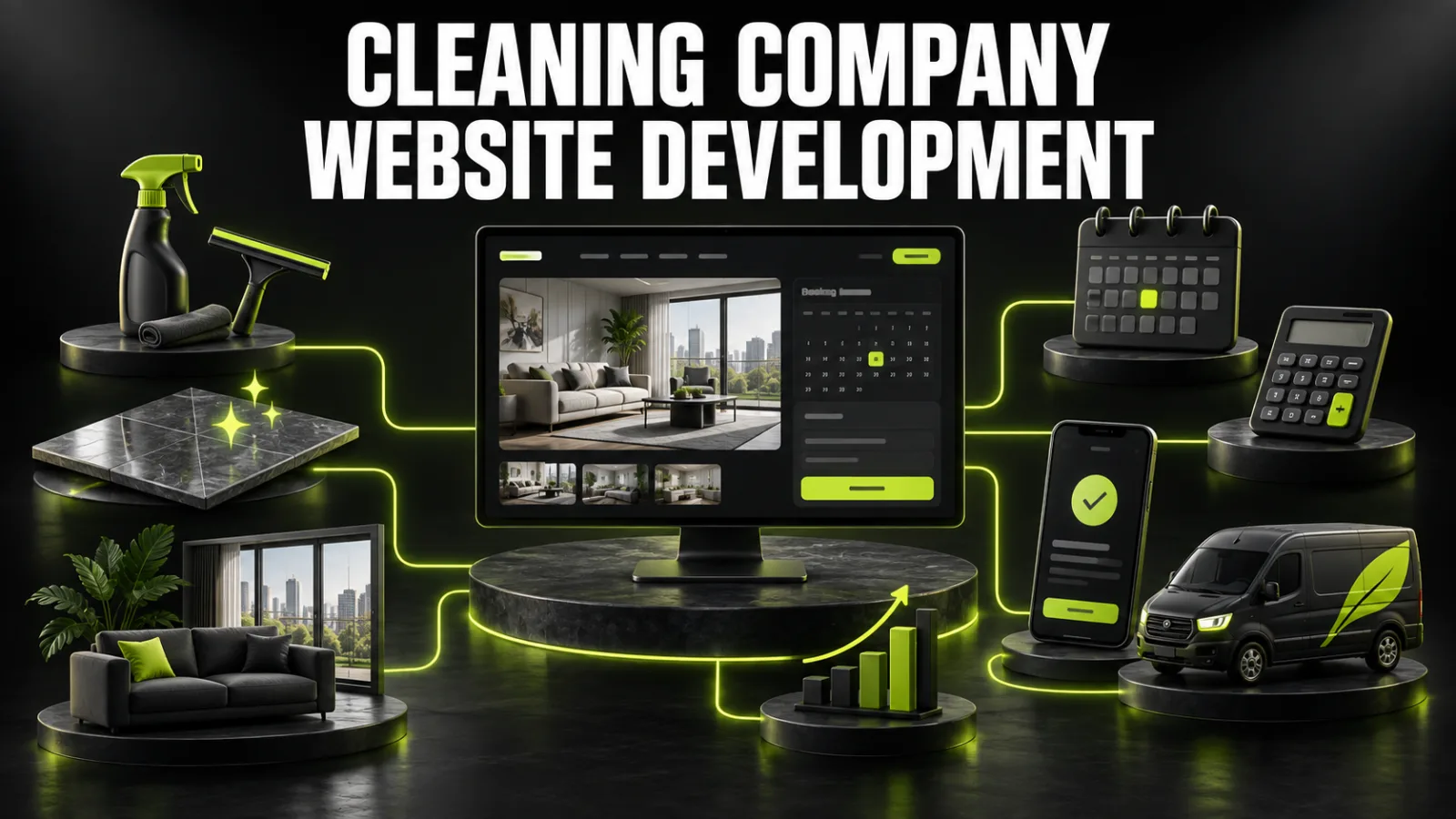
Cleaning customers often have an immediate task: prepare a flat for moving in, restore a property after renovation, clean an office before the next working day, or book a regular visit. They compare providers quickly. A website wins attention when it shows the right service, service area, expected price, scope of work, availability, and an easy next step without forcing the visitor to call for basic information.
For that reason, business website development for a cleaning company begins with the booking model. The site is a dispatch and qualification system, not merely an online brochure. It should collect the information needed to estimate, schedule, confirm, and later measure the job.
This is the best foundation for companies offering several cleaning types across one or more areas. Each major service receives a dedicated page with scope, exclusions, pricing logic, duration, photographs, FAQs, and a focused enquiry form. It can answer specific search intent far better than one generic page with short cards.
A landing page works for one focused offer such as post-construction cleaning, seasonal window cleaning, or a commercial cleaning campaign. Landing page development supports a clear paid-search journey, but a single page is rarely enough for a company seeking long-term organic coverage across several services.
This model fits standardised packages with controlled extras and manageable staff schedules. Visitors choose property type, size, rooms, add-ons, location, date, and time. The system gives an estimate while the company may retain final confirmation.
Offices, retail, residential complexes, warehouses, healthcare, and industrial sites require a different journey. The buyer provides floor area, frequency, shift requirements, compliance needs, and documentation. Case studies, quality control, service-level processes, and a request for proposal matter more than an instant consumer booking.
Help visitors select the correct cleaning type.
Explain the difference between maintenance, deep, and post-renovation cleaning.
Clarify what is included and excluded.
Give a useful price indication before a call.
Validate whether the address is covered.
Collect date, size, property condition, and add-ons.
Build trust with evidence rather than generic promises.
Send structured data to the CRM.
Attribute confirmed and completed jobs to their sources.
The broader planning principles are covered in this business website structure guide.
| Page | Purpose | Primary action |
|---|---|---|
| Home | present services, coverage, proof and a quick estimator | calculate a quote |
| Services | help visitors select the job type | open a service page |
| Service detail | explain scope, price, time and limitations | book or enquire |
| Pricing | show packages, add-ons and minimum order | request an estimate |
| Calculator | collect property and service parameters | view estimated price |
| Commercial | explain recurring B2B cleaning | request a proposal |
| Case studies | demonstrate condition, process and result | request similar work |
| Locations | confirm areas and travel terms | check an address |
| About | show team, standards, equipment and responsibility | proceed to booking |
| Blog | capture informational and local demand | visit a service page |
| Contact | provide opening hours and communication channels | call or message |
Do not place every offer on one generic services page. Build useful pages for the company’s genuine priorities:
deep house or apartment cleaning;
recurring maintenance cleaning;
post-construction and post-renovation cleaning;
end-of-tenancy and move-in cleaning;
window and facade cleaning;
upholstery and carpet cleaning;
office cleaning;
retail, hospitality, and commercial property cleaning;
specialist one-off work.
Each page needs more than a city or service name inserted into a template. Explain work by room or zone, approximate duration, team size, supplies, access conditions, price logic, examples, limitations, FAQs, and a relevant call to action.
Hiding every price creates low-quality calls and unnecessary quoting work. When an exact amount requires inspection, provide a meaningful starting point:
minimum visit charge;
starting price by property, room, or area;
tasks included in the core package;
charges for windows, balconies, appliances, upholstery, heavy soil, and urgency;
travel charges outside the main area;
conditions that require photographs or an on-site assessment.
A starting price without context can mislead. Visitors should understand which choices affect the total and why the final confirmed quote may differ from an automated estimate.
A useful calculator collects only variables that materially change the job:
cleaning type;
property type;
floor area or room count;
bathrooms;
optional tasks;
exceptional condition or access;
postcode or service area;
preferred date and time window;
contact details for confirmation.
Update the estimate as choices change and label it clearly as preliminary. Allow photograph uploads for work that cannot be assessed reliably through checkboxes. Do not gate the first step with a phone number; demonstrate value before asking for contact details.
An availability calendar must account for job duration, crew capacity, travel time, coverage zones, and buffers. If the website is not connected to a live scheduling system, call the chosen slot a preferred time rather than a guaranteed appointment.
After submission, display a full summary including service, address, date, estimate, extras, and the next confirmation step. Send the same structured data to the customer and staff. Provide a clear rescheduling and cancellation route so changes do not disappear across unrelated messaging channels.
Stock imagery and a claim of “professional quality” are weak proof. Stronger content includes:
genuine before-and-after images from the same angle;
case studies with area, condition, scope, crew, and duration;
staff screening or training processes;
named equipment and product categories;
guidance for children, pets, surfaces, and allergies;
verified reviews linked to service type;
a clear process for reporting and correcting missed items;
company details, B2B documentation, and privacy information.
Avoid absolute environmental or safety claims without evidence. Explain how products are selected and how sensitive surfaces are tested.
Cleaning is geographically constrained. The website and business profile should use consistent company details, telephone numbers, opening hours, services, address, or service area. Keep categories, photographs, links, and availability accurate.
Google describes local results through relevance, distance, and prominence. A website cannot alter physical distance, but it can make the service and coverage unambiguous and strengthen proof of reputation. A complete search engine optimisation programme should combine technical health, service content, local relevance, internal linking, and trustworthy citations.
Do not publish hundreds of near-identical neighbourhood pages. Create a local landing page only when the company genuinely serves the area and can provide unique travel terms, response expectations, local cases, reviews, and operational details.
Structured data can clarify business type, contact details, location, opening hours, and other facts. It must match the visible page. Markup is not a guarantee of a rich result and cannot compensate for thin or inaccurate content.
Breadcrumb structured data can also clarify hierarchy. FAQ markup should represent questions and answers visible on the page. Validate JSON-LD whenever a template or field changes.
Useful content answers questions people have before ordering:
deep cleaning versus regular cleaning;
preparing a property for post-renovation cleaning;
typical duration by property size;
how often an office should be professionally cleaned;
what professional window cleaning includes;
move-in and end-of-tenancy checklists;
how to compare a cleaning quotation;
care guides for common surfaces.
Each article should naturally lead to a relevant service without turning every paragraph into an advertisement. The wider small-business customer acquisition plan connects search content with other channels and retention.
Paid search can capture urgent demand when campaigns are segmented by service and geography. A query for post-construction cleaning should not land on a generic homepage. It should reach a page that explains the exact work, pricing, evidence, area, and enquiry route.
Exclude irrelevant and information-only terms, control service locations, align ads with operating hours, and test the full mobile journey. Google Ads management should connect calls, forms, and bookings with confirmed jobs rather than reporting clicks as business outcomes.
Track meaningful events:
service-page views;
calculator starts and completions;
date selections;
phone and messenger clicks;
form submissions;
photo uploads;
bookings confirmed by staff;
completed jobs and revenue;
repeat orders.
Pass source, campaign, landing page, service, size, address, date, estimate, and add-ons to the CRM. This supports optimisation by confirmation rate, revenue, margin, and repeat business instead of the cheapest unqualified lead.
Urgent service searches commonly happen on phones. The first screen should state the service, coverage, a price cue, and one primary action. Quote steps need large controls, appropriate keyboards, short labels, and visible progress.
Compress before-and-after images, avoid unnecessary heavy video, reserve image dimensions to prevent layout movement, and keep pop-ups from obscuring the calculator. Evaluate field Core Web Vitals as well as laboratory tests.
The budget depends on the operating model:
a core multi-page site with services, pricing, cases, forms, and analytics;
a quotation site with rules, extras, service zones, and uploads;
a booking platform with availability, resources, notifications, rescheduling, and CRM;
a B2B solution with proposal requests, documentation, and deeper integrations.
Languages, copywriting, local pages, design, client accounts, scheduling systems, and automation also affect scope. The main variables are explained in how much a website costs in 2026.
Analyse services, areas, pricing, crews, and confirmation rules.
Map search demand to pages.
Prototype consumer and commercial journeys.
Formalise calculator and availability logic.
Design mobile and desktop interfaces.
Build CRM, analytics, and notifications.
Write and upload service and location content.
Test calculations, forms, performance, and indexation.
Launch campaigns and improve conversion with real data.
Ongoing website support keeps pricing, forms, backups, analytics, and integrations reliable after launch.
placing every service on one thin page;
hiding prices or failing to explain variables;
collecting only a name and telephone number;
promising slots without checking crew capacity;
mass-producing duplicate city pages;
relying on generic stock photographs;
sending every advertisement to the homepage;
counting submissions instead of completed jobs;
building an awkward mobile calculator;
leaving forms and integrations unmonitored after launch.
every priority service has a dedicated useful page;
packages, extras, and minimum charges are clear;
calculator rules pass normal and edge-case tests;
time selection reflects actual resources;
forms send complete structured records to the CRM;
calls, messaging, and uploads work on mobile;
coverage information is current;
canonical, sitemap, robots.txt, and hreflang are configured;
analytics, ad conversions, and job statuses are connected;
error messages help visitors continue;
backups and maintenance ownership are defined.
An effective cleaning company website shortens the journey from urgent need to confirmed work. It separates services, explains scope and price, checks coverage, gathers job details, captures preferred time, and moves clean data into the CRM. Local SEO builds lasting entry points, paid search captures immediate demand, and completed-job analytics reveals real acquisition value.
To design the architecture, quotation logic, and conversion journey around your services and locations, contact BB STUDIO.
 Web development
 Web development
 Web development
 Web development
 Let’s create something amazing together
