We create digital solutions that work for businesses
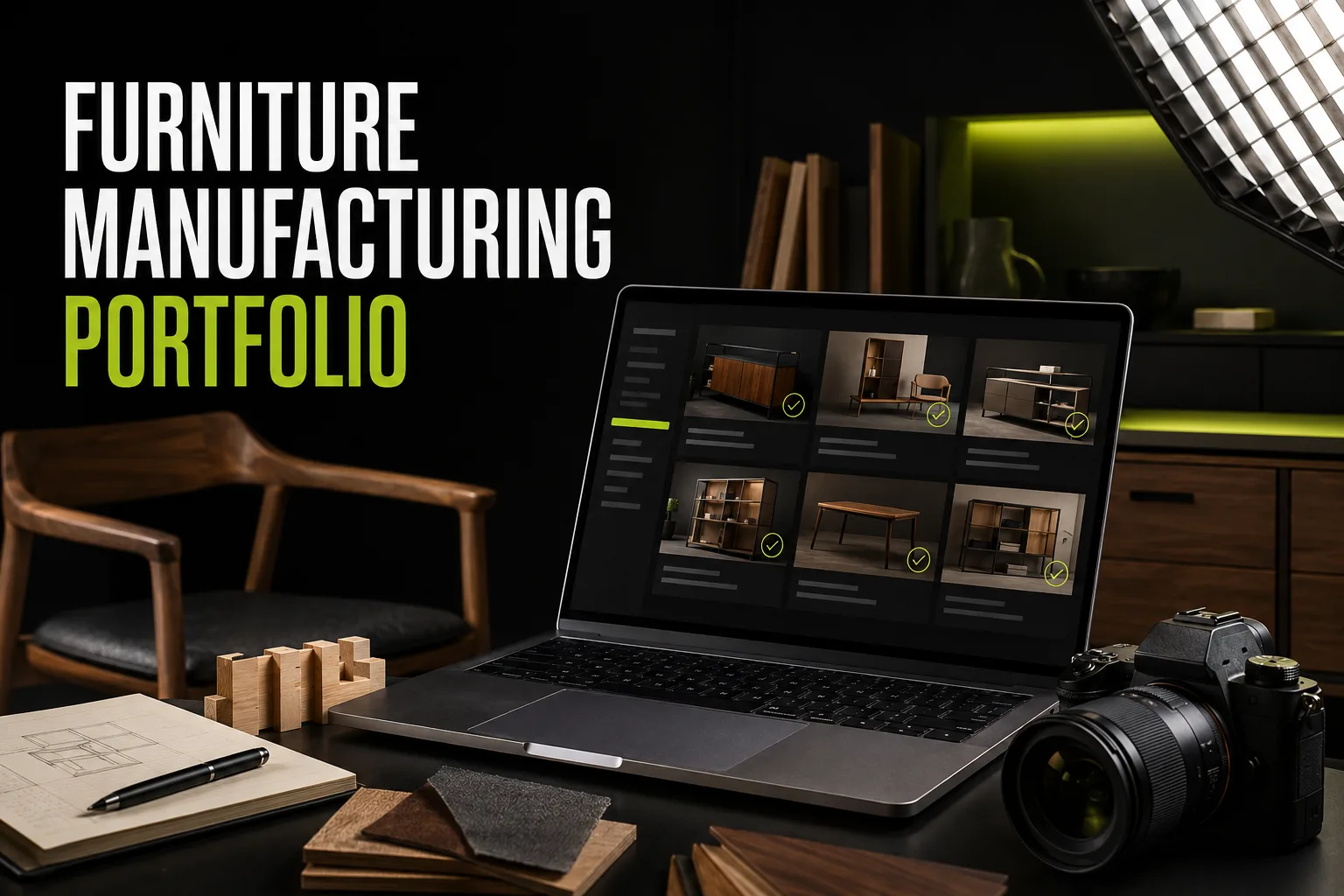
In bespoke furniture the client cannot look at the product — it does not exist yet. The only thing they judge by is the furniture portfolio: a hundred photos of other people's kitchens that either convince or leave them cold. The difference is not how beautiful the shots are but whether the person can picture their own flat and their own budget in their place. Let us look at what to shoot, how to caption it and why a photo from Pinterest works against you.
The fastest way to ruin a portfolio is to fill it with perfect renders from the internet. Clients browse dozens of sites in a row and recognise the same images. Then a simple thought follows: if the photos belong to someone else, perhaps the work does too.
A shot of your real kitchen in a client's flat, taken on a phone in daylight, works better than a studio render. It is imperfect — and that is exactly why it is believed. You can see it is an apartment rather than a set: the socket is in the wrong place, the window is on the other side, there is a kettle on the worktop.
So the rule is simple: only your own work goes into the portfolio. Renders can be shown separately, next to a photo of the finished result — that is even a strong move, because it proves the design and the reality match.
The crew has fifteen minutes after installation, and in that time they need to capture a set sufficient for a project page. The minimum is this.
A wide shot from the door — so the whole kitchen is visible and the scale is clear. A second wide shot from the opposite corner. Two or three close-ups: fronts and handles, worktop and sink, a corner or a non-standard solution. Open drawers and mechanisms are a must — that shows the internals the client is actually paying for. If there is an interesting solution such as a corner carousel or a built-in bin, give it its own frame.
Shoot in daylight with the lighting switched on, no people in frame and no post-installation debris. A phone is fine; the important thing is to wipe the lens and avoid shooting into the window.
A photo without data is just a picture. The same shot with four lines becomes a sales tool.
What the caption needs: type and size — "L-shaped kitchen 3.2 × 1.8 m"; materials — matt painted MDF fronts, quartz worktop, Blum hardware; production and installation time; the cost or a range; the district or city. Plus one sentence about the difficulty: "ceiling 3.1 m, we built mezzanine units right up to it" or "fridge fitted into a 58 cm niche".
That last line does the heaviest lifting. It shows you solve problems rather than just assembling boxes — and at the same time gives the client a hook: "I have a non-standard niche too."
A hundred projects without filters is a hundred projects in which nothing can be found. The client should reach a selection resembling their situation within a minute.
A working filter set for a furniture portfolio: type (kitchen, sliding wardrobe, walk-in closet, kids' room, living room), layout (single run, L-shaped, U-shaped, with an island), style (modern, classic, minimalism, loft), front material and budget in ranges.
Most workshops are afraid to add a budget filter — and that is a mistake. It filters out those who cannot afford you before they spend an hour of a manager's time, and simultaneously shows everyone else that you have options in their range.
A gallery where a photo opens in a lightbox is lost traffic. Every project should be a separate page with its own address: then it can be sent to a client in a messenger and ranks separately in search.
On such a page, besides photos and data: a list of materials linking to those material pages, similar projects, an "I want one like this" button with a form that already references this project, and a link to the calculator. We covered the calculator itself in detail in a kitchen price calculator on your site.
The "I want one like this" button is underrated. It is far easier for a person to press it than to describe to a manager what they want: the enquiry arrives with a link to a specific project, and the conversation starts on substance.
Twenty or thirty properly documented projects beat a hundred photos without data. If you only have ten — launch with ten, but document each one fully.
If the portfolio is very small, something else works: show the process. Photos of the workshop, equipment, cutting, assembly, the material store. Plus a detailed breakdown of one or two projects from measurement to installation — a kind of photo report. That convinces almost as well as a large portfolio, and it is honest.
After that the portfolio grows by itself if you introduce a rule: after every installation the crew drops photos into a shared folder named after the project. Within six months you accumulate thirty projects with no separate effort.
Furniture gets browsed in the evening from a phone, scrolling the gallery. If every photo weighs two megabytes, the page takes five seconds to open and the client leaves.
Technically this is solved by compression, a modern format and lazy loading: the browser only pulls the photos the person has scrolled to. A portfolio of three hundred shots should open in a second — that is how we build it, and it is a requirement rather than an option.
Checking is easy: open your portfolio from a phone on mobile data. If the first photos take longer than two seconds to appear, you are losing people at that step.
Properly documented project pages bring people from search on their own. Queries like "MDF front kitchen photo", "L-shaped kitchen 3 metres" or "walk-in closet in a niche" lead exactly to such pages when the captions carry specifics.
The second part is material pages: fronts, worktops, hardware. Each explains the difference in simple words and shows your projects using that material. This is traffic competitors usually do not collect at all.
How to get such pages into search in general we covered in how to reach the top of Google, and what a workshop website includes is on the page about custom furniture website development.
A portfolio does not exist on its own: it has to lead to an action. The shortest path looks like this — the client found a similar project, pressed "I want one like this", got an approximate range in the calculator and booked a measurement. Three steps, each on its own page, all tied together with links.
So every project page needs not only an "order" button but also a route to the estimate, while the calculator needs links to similar completed projects. That way the person moves along on their own and the manager joins an already prepared client.
It is also worth pulling reviews next to project photos: a review under a specific kitchen convinces more strongly than a general "Reviews" page. How to measure how many enquiries this produces and whether the site pays off is described in how to calculate a website's return.
A furniture portfolio works when it holds your own photos from real flats rather than renders from the internet. Each project is its own page with dimensions, materials, timeline, price and one sentence about the difficulty. Filters by type, layout and budget, an "I want one like this" button and a fast gallery that does not lag on a phone. Twenty such pages sell better than a hundred anonymous pictures.
 Design & UI/UX
 Design & UI/UX
 E-commerce
 Artificial Intelligence
 Let’s create something amazing together
